




.jpg)
WOCULT's research on the pressures wearing down working professionals ranks poor leadership , burnout and toxic culutre on #1 , #2 & #7 Here is the complete research piece . We interviewed Anja Driesmans and here is the full conversation.
Q1. “Poor leadership” is something almost everyone complains about but few people define clearly. What does poor leadership actually look like on an ordinary working day and which behaviours do the most damage?
For me, poor leadership rarely looks dramatic. It is usually much more ordinary than that. It is the leader who creates uncertainty, changes priorities without explanation, avoids difficult conversations, micromanages one day and disappears the next, or expects people to somehow know what is required without giving them the context or support to succeed.
It is also what happens when a leader takes credit but avoids accountability, listens selectively, or creates an environment where people spend more energy managing the leader than doing their actual job.
The most damaging behaviour, in my experience, is inconsistency. When people cannot predict how a leader will react, psychological safety disappears very quickly. People stop asking questions, stop challenging ideas and start protecting themselves.
And once people are protecting themselves rather than contributing fully, you have a much bigger organisational problem than simply having a difficult manager.
Q2. Some leaders deliver strong numbers while exhausting the people around them. How do you recognise the difference between a demanding leader and a genuinely harmful one?
Being demanding isn't inherently bad. Some of the best leaders I have encountered have had very high standards. The difference is whether the pressure creates better performance or fear.
A demanding leader can say, “This isn't good enough,” while still making you feel respected, supported and capable of improving. They hold themselves to the same standards. They are clear about what matters and they understand that people are human beings, not just resources.
A harmful leader often gets results through fear, unpredictability, humiliation, excessive control or constant pressure. The numbers might look good for a while, but underneath them you start seeing exhaustion, silence, high turnover and people becoming less willing to take risks.
I think one of the simplest tests is this: What happens to people around the leader over time? If people consistently become smaller, quieter, more anxious and more exhausted, then strong numbers don't tell the whole story.
Q3. Why do poor leaders often survive longer than the people they drive away? What allows an organisation to keep rewarding someone whose leadership is damaging the team?
Because organisations often measure what is easiest to measure. Revenue, targets, deadlines and productivity appear on a dashboard. Fear, anxiety, loss of trust and the gradual erosion of a team's confidence don't.
There is also a tendency to protect people who are seen as commercially valuable. If someone consistently delivers numbers, organisations can convince themselves that the human cost is unfortunate but acceptable.
And sometimes the people experiencing the problem leave before the organisation ever gets the full picture. Their departure can then be interpreted as an individual choice rather than a signal about the environment they were leaving.
I think that's one of the biggest leadership mistakes: treating turnover as a series of unrelated resignations rather than asking, “What is this pattern telling us?”
At some point, if the same people keep leaving and the same manager remains, the organisation needs to stop asking why employees can't cope and start asking what the manager is creating.
Q4. Toxic culture rarely starts with one dramatic incident. What are the quieter signs that a workplace culture is becoming unhealthy before people start calling it “toxic”?
You notice it in the things people stop doing. They stop speaking openly in meetings. They have the real conversation afterwards, privately, rather than in the room. People become careful about emails and start documenting everything “just in case.” Meetings become performative. Bad news gets softened or hidden because people are afraid of the reaction.
You also see people becoming emotionally detached. They do what is asked, but they stop bringing ideas, challenging assumptions or going the extra mile.
Another warning sign is when people constantly talk about being overwhelmed but the organisation treats that as normal. When “busy” becomes a badge of honour and nobody feels able to say that something is unrealistic, the culture is already telling you something.
For me, one of the clearest signs is when people no longer believe that honesty will improve anything. Once people decide that speaking up is pointless—or dangerous—you have a serious cultural problem.
Q5. How much responsibility for a toxic culture sits with leadership? Can a toxic culture survive under a good leader, or does leadership ultimately determine what behaviour an organisation will tolerate?
Leadership doesn't create every behaviour in an organisation, but leadership absolutely determines what gets rewarded, what gets challenged and what gets tolerated.
A good leader cannot control every individual or prevent every unhealthy dynamic. But they can make it very clear what is acceptable and what isn't and, crucially, they can demonstrate that through their own behaviour.
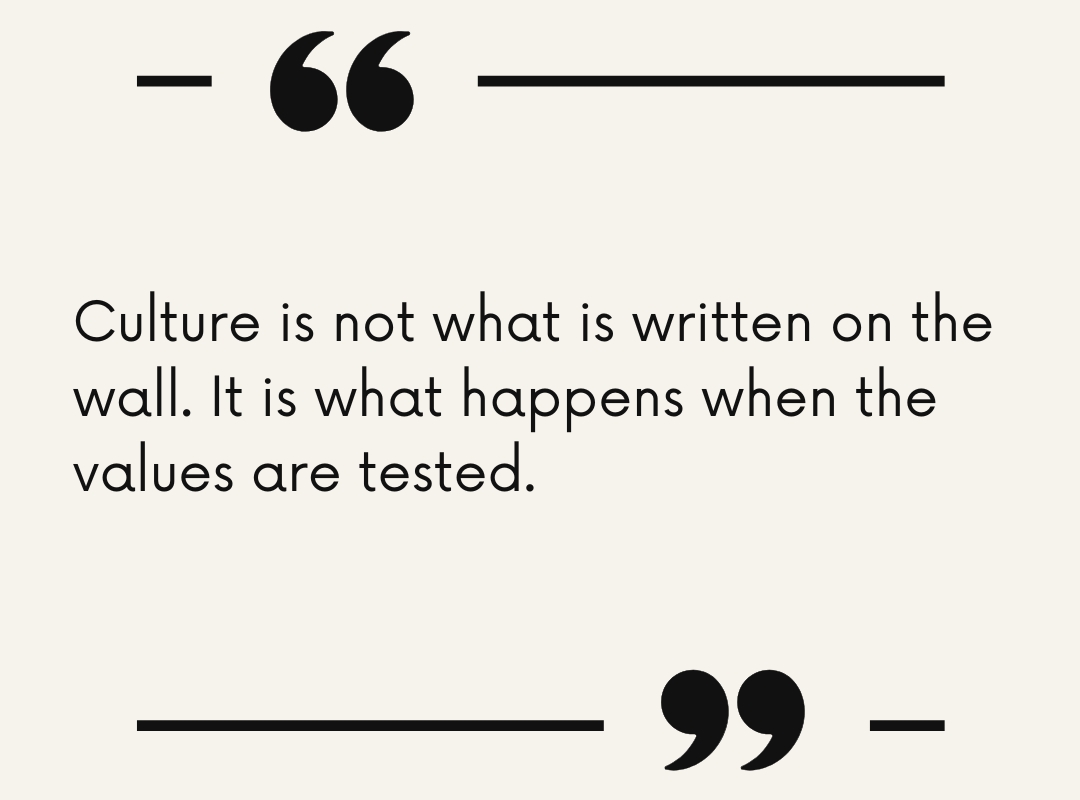
Culture is not what is written on the wall. It is what happens when the values are tested.
If an organisation says it values respect but consistently promotes people who intimidate others, the real culture is not respect. If it says people should speak up but punishes people who challenge senior leaders, the real culture is silence.
So yes, a toxic culture can exist even with good people in leadership. But if unhealthy behaviour becomes systemic and leadership repeatedly chooses not to address it, responsibility eventually sits at the top.
Q6. Burnout is often treated as an individual problem, which employees need to manage through better boundaries, resilience or self-care. What gets missed when we frame burnout that way?
We risk turning a structural problem into an individual failure. Of course boundaries matter. Rest matters. Resilience matters. But telling someone who is working in an environment of constant unrealistic demands to simply become more resilient misses the point.
If the workload is fundamentally unreasonable, if priorities constantly change, if there is no recovery time, if people are rewarded for being permanently available, no amount of meditation or time-management advice is going to solve the underlying problem.
I've become increasingly convinced that we need to ask a different question. Not just, “How can this person cope better?” but “What are we asking this person to cope with?”
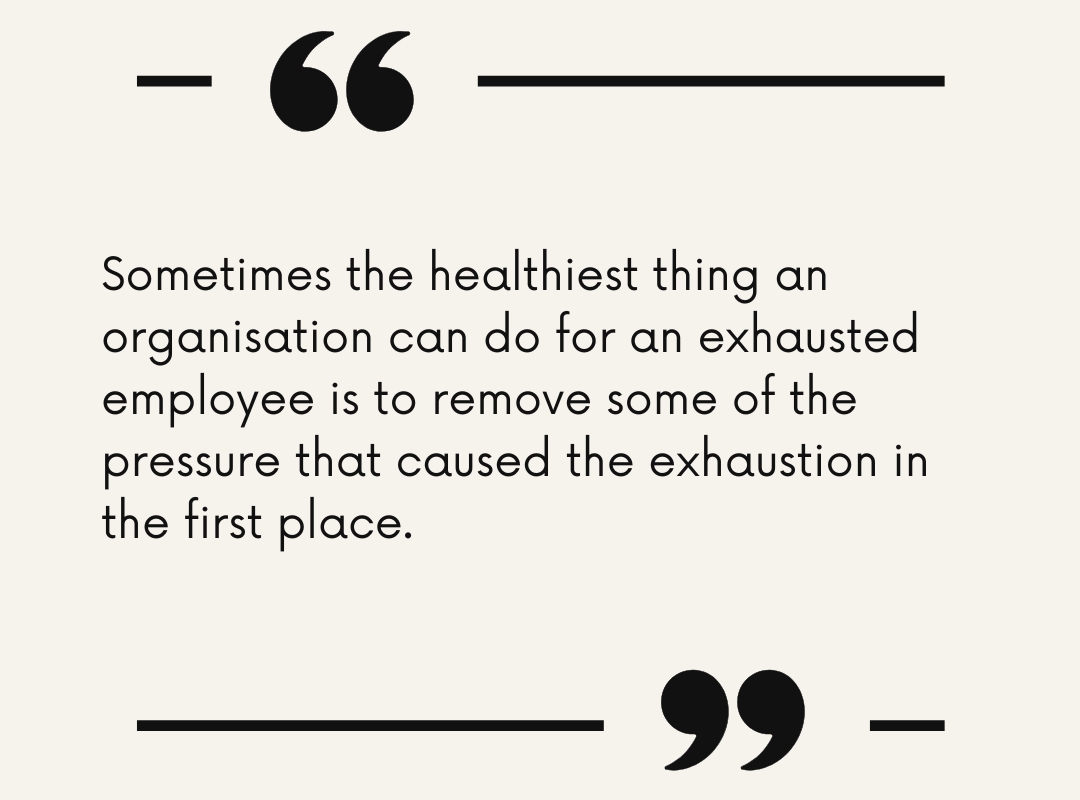
Sometimes the healthiest thing an organisation can do for an exhausted employee isn't offer another wellbeing initiative. It is to remove some of the pressure that caused the exhaustion in the first place.
Q7. At what point does workplace pressure become something more serious? What role do poor management, unrealistic expectations, lack of psychological safety, constant urgency or the inability to switch off play in pushing people towards burnout?
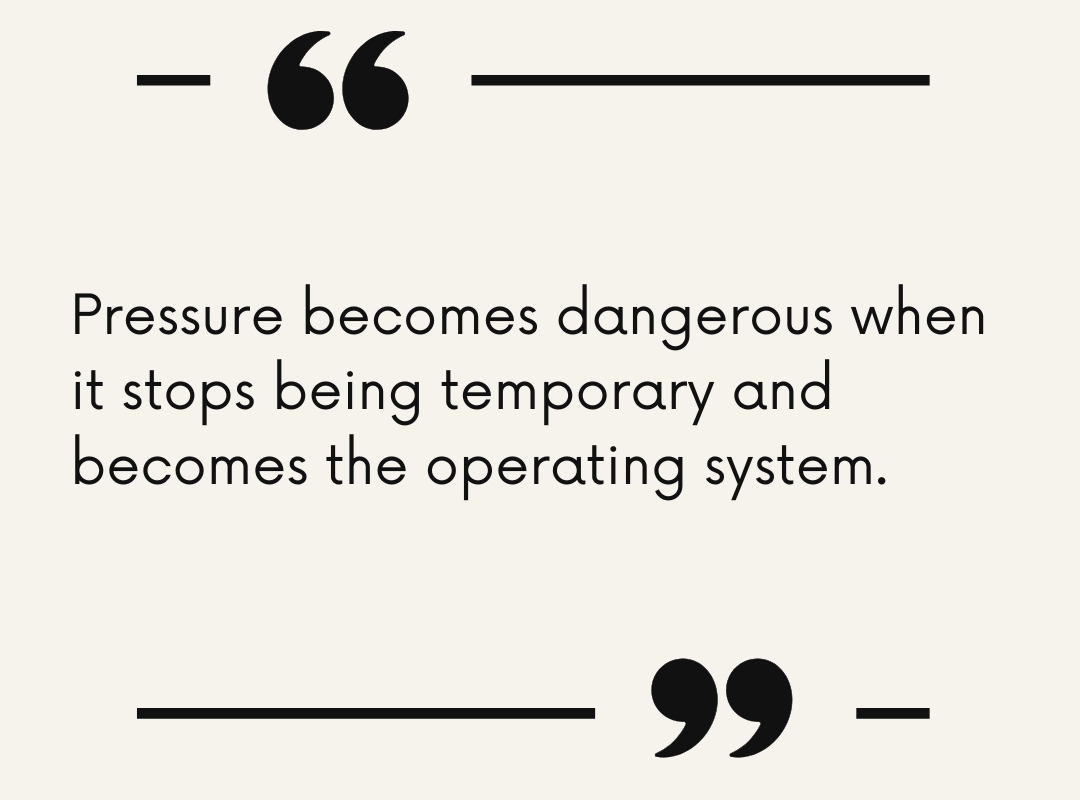
Pressure becomes dangerous when it stops being temporary and becomes the operating system.
There will always be intense periods at work. A difficult project, a major deadline or a crisis can require people to stretch. The problem comes when everything is treated as urgent, all the time, and there is never a genuine period of recovery.
Poor management makes that significantly worse because people don't know what they can safely deprioritise. If everything is important, nothing is actually prioritised.
Psychological safety matters enormously too. If people can't say, “I can't realistically deliver all of this,” the workload doesn't disappear. It just moves underground. People work longer hours, hide the strain and eventually reach a point where they have very little left.
The inability to switch off is another major warning sign. When your body has left work but your mind is still there every evening and weekend, that is not sustainable performance. It is sustained activation.
Q8. Why do people stay silent inside unhealthy workplaces? What makes employees tolerate poor leadership or toxic behaviour even when they know something is wrong and what does an organisation need to do before “speak up” becomes genuinely safe?
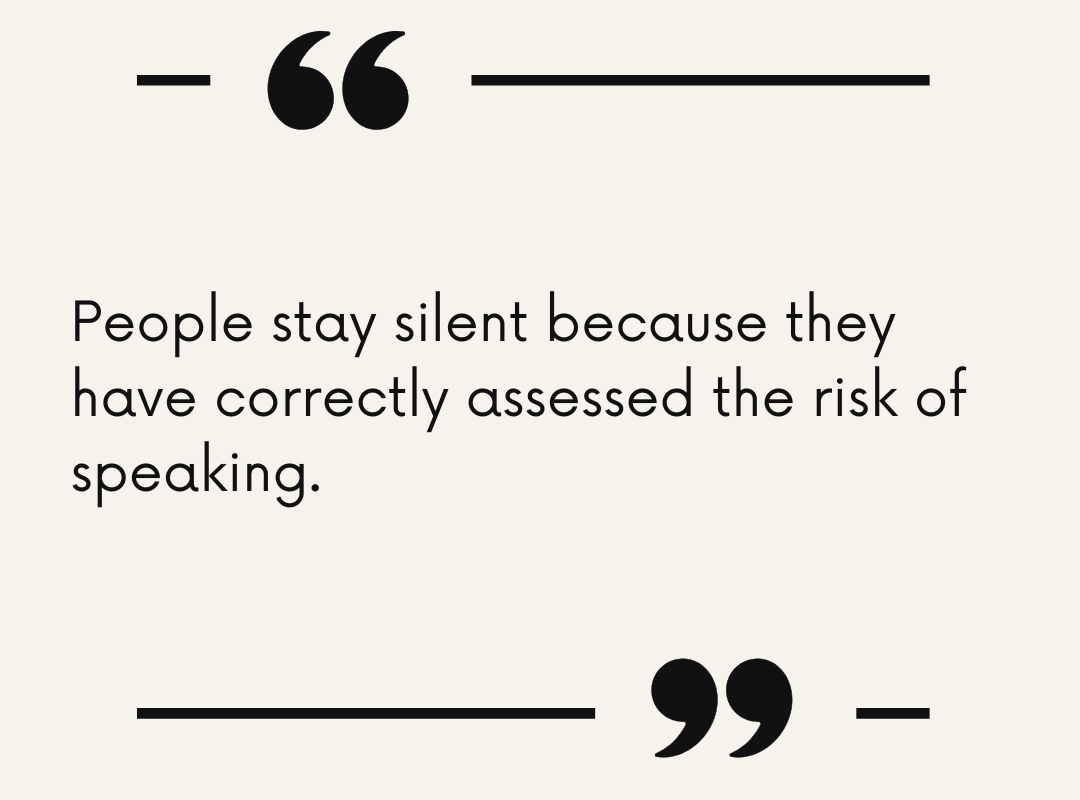
People don't stay silent because they don't know something is wrong. Quite often, they stay silent because they have correctly assessed the risk of speaking.
People watch what happens to the person who challenged the boss. They notice who gets promoted, who gets excluded, whose concerns disappear into a process and who suddenly becomes labelled “difficult.”
Trust is built through evidence. You cannot tell people, “We want you to speak up,” and then respond defensively when they do. Psychological safety isn't created by a policy or a campaign. It comes from repeatedly demonstrating that people can tell the truth without being punished for it.
And leaders have to be prepared to hear things they don't like. The real test of a speak-up culture isn't whether people have somewhere to report a problem. It is whether they genuinely believe that something constructive will happen after they report it.
Q9. Can toxic cultures actually be changed from within? What needs to happen beyond policies, wellness programmes and leadership statements for employees to genuinely feel that the culture has changed?
Yes, I believe they can changebut not through messaging alone. Culture changes when behaviour changes consistently over time.
That means being honest about what created the problem in the first place. It means holding powerful people accountable, not just easier targets. It means changing incentives when the incentives are producing unhealthy behaviour. It means listening to employees and then visibly doing something with what you hear.
There also needs to be patience. People who have experienced a poor culture don't immediately trust a new leadership statement simply because the statement is better.
They watch what happens when someone disagrees with the boss. They watch whether workloads actually change. They watch whether difficult behaviour is challenged. They watch whether promotions and recognition go to people who live the stated values.
Eventually, behaviour becomes evidence. And evidence is what starts rebuilding trust.
Q10. What responsibility do senior leaders have when they discover that a high-performing manager is also creating fear, burnout or dysfunction within their team?At what point should performance stop being an excuse?
Performance should never be a licence to damage people. Senior leaders have a responsibility to look beyond the manager's own results and understand the environment in which those results are being produced.
If someone is delivering exceptional numbers while their team is burning out, people are leaving, trust is collapsing and fear is becoming part of the management model, then the numbers are not the whole performance story.
I think this is where leadership courage matters most. It is relatively easy to hold an underperforming person accountable. It is much harder to challenge someone who is commercially successful but culturally damaging.
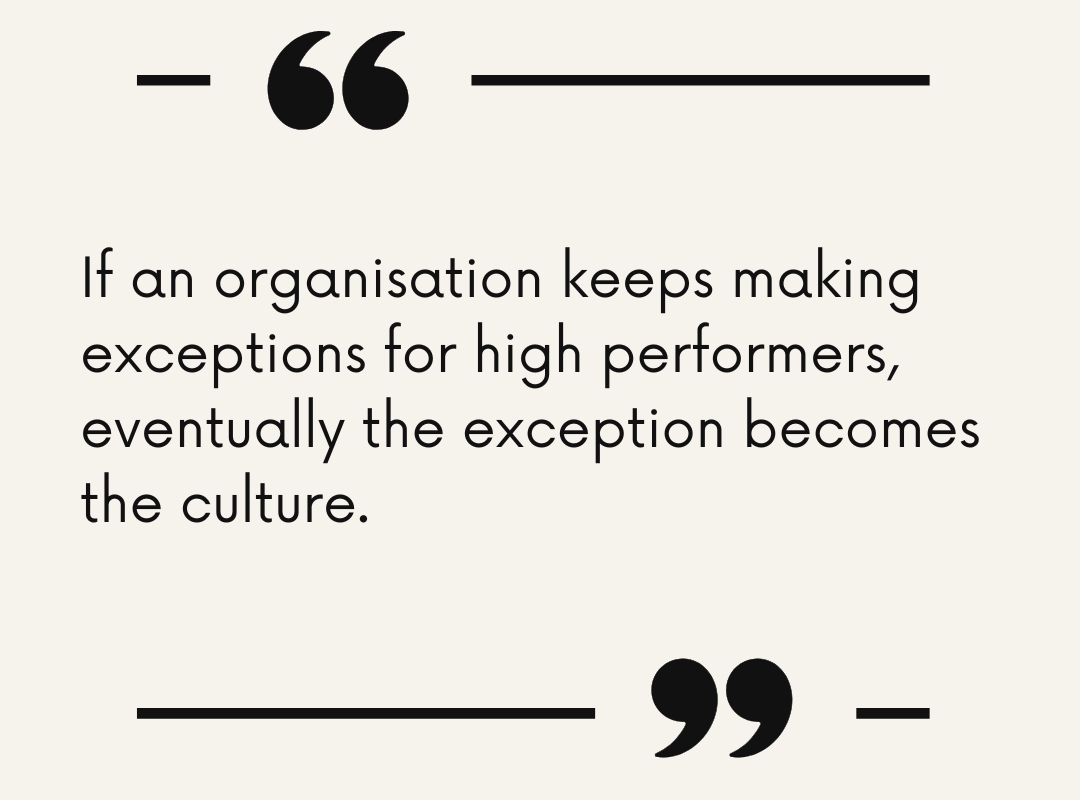
But if an organisation keeps making exceptions for high performers, eventually the exception becomes the culture. The message everyone else receives is very clear: results matter more than how you achieve them. And once people believe that, you shouldn't be surprised when the culture starts reflecting it.
Q11. For someone who is currently working under a poor leader or inside a toxic culture and starting to wonder whether the problem is them, what is the one honest thing you would tell them?
I would tell them: don't let someone else's behaviour become the evidence you use to judge your own worth.
When you're in an unhealthy environment for long enough, you can start questioning yourself. You wonder whether you're too sensitive, not resilient enough, not performing well enough, or somehow responsible for the tension around you. That is one of the most damaging things about a poor culture—it can slowly distort your sense of what is normal.
So step back and look at the pattern rather than every individual incident. Ask yourself: Was I like this before? Do I feel like myself here? Are other good people experiencing the same thing? Am I constantly trying to adapt to behaviour that I would never consider acceptable from myself?
Sometimes the problem really is something we need to work on in ourselves. But sometimes the environment is making you doubt yourself because it is unhealthy.
And I think it's important to remember that leaving an unhealthy environment is not necessarily giving up or failing. Sometimes it is recognising that you deserve to work somewhere that allows you to do good work without losing yourself in the process.
You don't have to prove your resilience by staying somewhere that is breaking you.
.jpg)
About Anja Driesmans
Anja Driesmans is a transformation and organizational development professional working at the intersection of culture, resilience, and human-centered transformation. With a background spanning transformation management, organizational development, and therapeutic practice, she brings a distinctive cross-disciplinary perspective to the challenges leaders and organizations face in increasingly complex environments.
Her work focuses on regenerative leadership and sustainable systemic transformation. She supports executives, leadership teams, and organizations in moving beyond traditional approaches to change by integrating strategic performance with human, relational, and systemic dynamics.
Through systems thinking, trauma-informed practices, nervous system awareness, and culture transformation, Anja helps organizations build greater resilience, psychological safety, adaptability, and long-term sustainability while maintaining strategic clarity and high performance.
She approaches organizations as living systems, recognizing that sustainable transformation is shaped not only by strategy, structures, and processes, but also by the human and relational fields that influence how people respond, connect, lead, and adapt.
At the heart of her work is a belief that transformation should not deplete people and systems, but restore vitality and strengthen their capacity to thrive. She is particularly interested in the shift from extractive models of leadership and work toward regenerative ways of leading, organizing, and creating impact.
In parallel, she supports individuals navigating stress, trauma, and burnout in reconnecting with greater inner stability, clarity, and groundedness enabling them to live and lead with greater presence and meaning. Anja’s work ultimately explores a fundamental question: How can organizations transform in ways that strengthen, rather than diminish, the conditions for human and systemic vitality?

%20(1).png)

.png)