



%20(1).png)
WOCULT's research on the pressures wearing down working professionals ranks bad managers and poor people leadership at number one above burnout and job insecurity. Here is the complete research piece .
We interviewed Mahi Rath and here is the full conversation.
Q . Our research puts bad managers and poor people leadership at number one above burnout and job insecurity. You've built People & Culture inside companies growing at speed. What does a bad manager actually cost a company and why does bad management seem to multiply exactly when a company is scaling fastest?
The research putting bad management above burnout and job insecurity does not surprise me. People can survive hardwork and uncertainty. What they cannot sustain is feeling unseen or unsafe with the person who has the most direct power over their day. The question I keep coming back to is not just how do we remove bad managers. It is how do we stop building systems that manufacture them.
One bad fish contaminates the entire tank. That is the simplest way I can describe what a bad manager does to a team, and I have seen it play out more times than I would like to count across my years building People and Culture inside fast moving organisations.
The contamination is rarely the obvious stuff. Attrition, disengagement, performance dips are just the surface. The real cost is the invisible tax. The high performer who stops raising her hand because she learned it was not safe to. The new joiner who calibrates down within 90 days because that is the energy the room carries. One person, one role, ripple effects that go three layers deep before anyone pulls the thread.
Now add hypergrowth to that equation. Companies scaling at speed promote for output, not for people leadership. The engineer who shipped the most gets a team. The top individual contributor becomes a manager overnight. People in positions of authority who have never had to hold someone else's wellbeing alongside their own targets. That is not a character failure. That is a systems failure.
What does it cost? More than most finance teams are measuring. Beyond the 1.5 to 2x salary cost of replacing someone who resigned, there is what I call psychological safety debt. When trust erodes inside a team, you do not see it on a dashboard until it is already expensive. The people with the most options, your best people, do the math first and leave.
Q. What are the clearest signs of a genuinely bad people-leader and of all the types you've seen, which one does the most damage while being hardest to spot?
The clearest signs of a genuinely bad people leader are almost never the dramatic ones. It is rarely the person who shouts in meetings or takes obvious credit for others' work. Those are easy to see and easier to act on.
The signs I have learned to trust are quieter. Teams that stop disagreeing with their manager because disagreement stopped feeling safe. High performers who suddenly go invisible, delivering just enough, no more. Exit interviews where people say the role was fine but their eyes tell a different story.
But the type that does the most damage while being the hardest to spot? The Approval Addict. This is the manager who is universally liked. Genuinely warm. Gets great pulse scores. Leadership sees a culture champion. HR sees low noise. And underneath all of that, their team is literally drowning.
The Approval Addict cannot have a hard conversation to save their life. They avoid performance feedback because they need to be loved. They agree with whoever is in the room, which means their team never gets a clear direction. They will smile at you in a one on one and then escalate around you to your skip level because direct conflict is unbearable to them. They shield their people from accountability not out of protection but out of personal discomfort.
What makes them so dangerous is that they generate no formal complaints. Nobody writes a grievance about the manager who is always so kind. But the team is not growing, is not being advocated for in the rooms that matter, and is slowly being conditioned to believe that niceness is the same thing as leadership.
And then there is a second type that took me even longer to name. Because on paper, they are outstanding. Brilliant with senior leadership. Articulate, strategic, composed. They manage up with extraordinary skill and their executive presence is impeccable. Ask their peers and you will hear nothing but praise. Ask their team and you will hear something very different. This is the Visibility Hoarder.
The leader who shows up fully for every conversation that benefits their own career and goes almost completely absent for every moment that could have elevated someone else's. Their team has spent months building something genuinely impressive. A product, a solution, a body of work that represents real craft and real effort. And when it is time to present that work to the ELT, the manager walks in alone. The team watches from outside the room or hears about it secondhand.
The other sign is subtler but just as telling. Nobody on that team sends a single email or raises a single idea without copying their manager. Not because they are disorganised. Because they learned somewhere along the way that visibility had to be filtered, and that gatekeeper was not opening the door. What this does over time is devastating. Confidence erodes. High performers start asking themselves why they are building things that someone else gets to present. And eventually they stop building as hard.
The Visibility Hoarder is dangerous because their own metrics look clean. Results land. The organisation sees performance and does not always think to ask who produced it, or what it cost those people to do it without recognition.
I have deep conviction about this one. One of the most powerful things a leader can do is put their team in the room. Not instead of themselves. Alongside themselves. That moment costs a leader nothing and gives a team member everything. The leaders who never do it are not just failing their teams. They are building cultures where talent learns to stay small.
Q. You've held 90+ engagement scores and a 4.9 Glassdoor rating through rapid change. How early does a bad manager show up in the data, what's the first signal, before the good people start leaving?
Earlier than most organisations are willing to look. The data does not lie, it just gets ignored or explained away. A bad manager shows up in the numbers long before the resignation letters land. The problem is we have trained ourselves to look for exits as the signal, when the signal was always there much earlier, waiting for someone to ask the right question.
The first signal is never attrition. It is participation. When response rates drop in one pocket while remaining healthy everywhere else, that is the earliest flag I take seriously. People do not go silent because they have nothing to say. They go silent because they have stopped believing it will change anything. And that loss of belief almost always has a manager's fingerprints on it.
The open text in your engagement data tells you even more than the scores. When the language shifts from "we" to "I", when people stop writing about their team and start writing only about their own work, something has already fractured. I read every single comment. That shift in language is the thing that keeps me up at night.
But data only tells you what people were willing to write down. The rest lives in the room.
I have never been someone who sits behind a closed office door waiting for problems to arrive formally. I move around. I sit in different spots. I set up random zooms with no agenda, just a genuine check in. Over time that builds the kind of trust where someone feels comfortable walking up to me and saying something they would never put in writing. That is where the real signals live.
I also look closely at performance plans. Because one of the quietest ways a bad manager shows up in the system is by converting a relationship problem into a performance problem. That distinction matters and it requires a people leader willing to go looking for it rather than simply signing off.
And I treat exits with the same intentionality as onboarding. How we close that chapter determines whether someone walks away feeling respected and heard. People who have left come back as advocates, as referrals, as returning talent, because they remember being treated like they mattered all the way to the end.
Strong engagement scores through rapid change are not the result of a single program. They are the result of consistent presence, genuine relationships, and the discipline to look for the truth before it becomes a trend.
The data tells you where to look. The relationships tell you what is really there.
Q. Why do bad managers so often survive longer than the good people they drive away and what does a company usually actually do when someone reports a manager who happens to be senior or high-performing?
This is the question that sits at the heart of almost every culture problem I have ever seen. And the honest answer is uncomfortable.
Bad managers survive longer than the good people they drive away because organisations are structurally designed to protect performance, not people. And in most companies those two things are still being measured very differently.
The senior manager hitting their numbers, delivering their roadmap, keeping their stakeholders happy, that person has built institutional armour. Their relationships are with the people who make decisions about their future. So when someone below them raises a concern, the organisation does not always see a leadership problem. It sees a friction problem. Something to be smoothed over quietly.
I have seen it more times than I would like to admit. Someone finds the courage to report a manager. They go to HR or their skip level and say something is wrong. And what follows is rarely what the policy says should happen. What actually happens is a calculation. How senior is this person? How hard to replace? How much noise will this make? The response gets calibrated accordingly.
The person who raised the concern gets a conversation about being heard. Maybe a mediation. Maybe a quiet move to another team dressed up as a development opportunity. The manager gets a closed door conversation that amounts to very little. Because the organisation has already decided the cost of acting is higher than the cost of waiting.
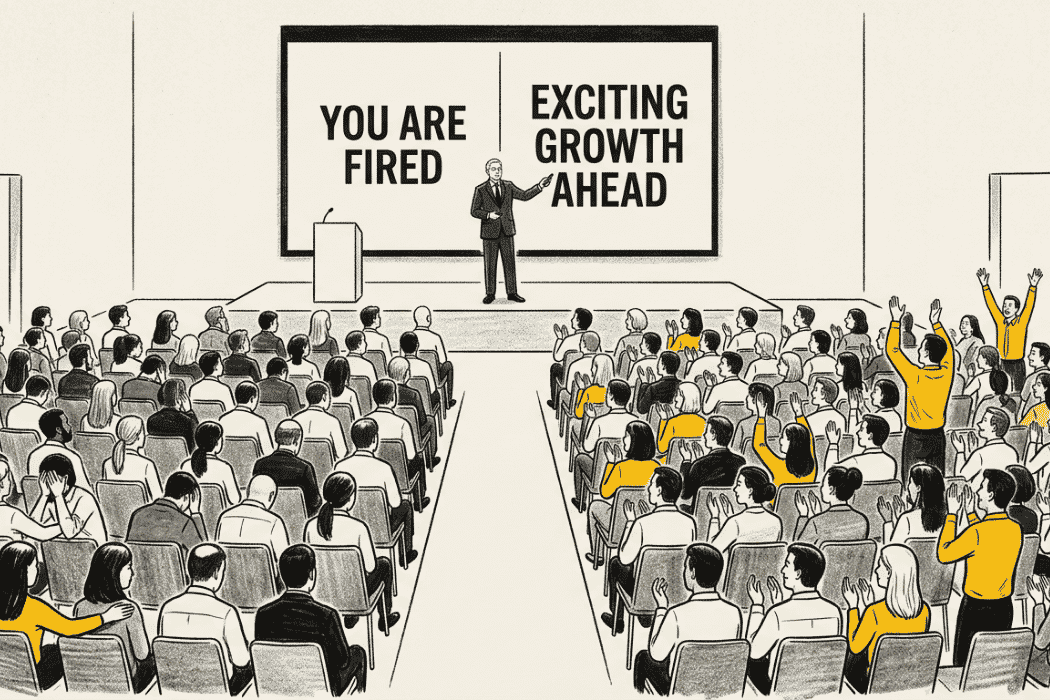
What this does to a culture is catastrophic and cumulative. Everyone is watching. The team sees what happened to the person who spoke up. And they all update their behaviour accordingly. They stop reporting. They start leaving instead. Quietly, professionally, without drama. And the organisation loses the wrong person every single time and calls it natural attrition.
The good people leave faster because they have options and because they have self respect. They are not willing to wait for a system that has already shown them where its priorities lie.
.png)
In my own work I have always held one line clearly. Seniority is not a shield. High performance in your function does not give you the right to cost the organisation its best people. And if someone has found the courage to raise a concern, the very least I owe them is to make sure they feel heard, protected, and never made to feel that speaking up was the wrong decision. Because the moment people stop reporting is the moment the culture belongs to whoever is willing to behave the worst.
.png)
Q. When you're hiring fast and making new managers every month, good people leadership can't be left to chance. How do you build it in on purpose and what's the one thing organisations consistently fail to give first-time managers?
When you are hiring fast and creating new managers every month, good people leadership cannot be left to chance. And yet that is exactly what most organisations do. They promote someone on a Friday and expect them to lead a team by Monday. No transition, no framework ,no honest conversation about how different this job actually is from the one they just left. Good people leadership is built on purpose or it is not built at all. In a company growing fast, every manager you create is either multiplying your values or multiplying the problem. That is a choice that needs to be made consciously.
The one thing organisations consistently fail to give first time managers is permission to not have all the answers. We set them up with targets, tools, and a team, and then leave them to figure out the human part alone. And the human part is the whole job. But before we get there, something more foundational. Culture is not a value on a wall. It is a behaviour that gets modelled, reinforced, and sometimes protected at significant cost. If you are not intentional about transferring it to every new manager who joins or gets promoted, you are not scaling your culture. You are diluting it.
.png)
In my own work, whether someone is promoted internally or brought in from outside, instilling values starts before their first day in the new role. Not with a handbook. With a conversation. About what this organisation actually believes about people. How we treat someone on their worst day. What leadership looks like here versus what it looked like somewhere else they have been.
For internal promotions the challenge is equally important. Someone who has lived inside the culture as an individual contributor does not automatically carry it forward as a manager. The transition changes their relationships, their visibility, and their power. I have seen deeply values aligned people become very different managers because nobody walked them through what that shift meant or what was now expected of them as a cultural carrier.
For external hires I am always watching for the gap between what someone says about culture in an interview and how they behave in their first sixty days. Do they listen before they lead? Do they ask questions or arrive with all the answers? Do they make their team feel seen or immediately start replicating what worked in their last company?
Values are not an onboarding module. They are a recurring conversation. In one on ones, in how we review performance, in how we handle hard moments, in who gets celebrated and for what. Every decision a manager makes is either reinforcing the culture or quietly eroding it. My job is to make sure they know which one they are doing.
The organisations that get this right treat culture transfer as seriously as skill transfer. They hold the line even when the new manager is talented and delivering results. Because results that come at the cost of your culture are not results worth celebrating.
.png)
Good people leadership is built on purpose or it is not built at all. In a company growing fast, every manager you create is either multiplying your values or multiplying the problem. That is a choice. It just needs to be made consciously
Q. Bad management doesn't hit everyone equally. You've built teams across India and APAC, much of it remote or hybrid. Who pays the highest price under a bad manager and does distance make bad management worse, or just easier to hide?
Bad management does not hit everyone equally. That is one of the most important and least discussed dimensions of this conversation.
The people who pay the highest price are almost always the ones with the least structural protection. The newest person on the team who has not yet built relationships beyond their immediate manager. The quieter contributor who relies on their manager to make them visible. The person from a culture where challenging authority is not something you do openly, where disagreement is expressed differently, where hierarchy carries a different kind of weight.
In the India and APAC context this matters enormously. I have worked with incredibly talented people who would never walk into a skip level meeting and say my manager is the problem. Not because they lack courage but because the cultural architecture around them does not make that feel safe. So they absorb it. They deliver quietly and suffer quietly and eventually leave quietly. And the organisation records it as voluntary attrition and moves on.
.png)
Women on teams with bad managers also pay a disproportionate price. The Approval Addict never gives the direct feedback a woman needs to grow and be sponsored into the next role. The Visibility Hoarder never puts her in the room where it matters. The patterns of bad management land differently on people who were already navigating additional barriers before their manager became one too.
Now add distance to that equation. Remote and hybrid work did not create bad managers. But it gave them somewhere to hide. When you are not in the same room the signals disappear. You cannot see that someone has gone quiet. You cannot feel the energy shift in a team. A manager who never checks in, never creates space for real conversation, never notices who is struggling, can go months without anyone above them realising nothing meaningful is happening for that team.
But distance also amplifies the impact on the people already most at risk. The new joiner in Bengaluru whose entire experience of this organisation is mediated through one disengaged manager. The remote team member already navigating isolation whose only anchor to the company is someone who does not show up. For these people a bad manager is not just a workplace problem. It is their entire workplace.
What I have learned building teams across geographies is that proximity to leadership matters more than people admit. Not physical proximity. Relational proximity. The feeling that someone with influence and authority actually knows you exist, knows what you are working on, and would notice if something was wrong. That is what a bad manager destroys first. And in a remote or hybrid world, once it is gone, it is very hard to re-build from a distance.
About Mahi Rath
Mahi Rath builds the people foundations that let organizations scale without losing themselves. Across 15 years, working exclusively in tech, she has partnered with high-growth startups and global organizations through the hardest part of scaling. She leads AI-first People & Culture transformations that make the employee experience stronger even as everything else moves faster. From talent acquisition to people operations, HR business partnering to L&D, she has built and scaled people functions end-to-end. The proof is in the numbers: 90+ engagement scores, a sustained 4.9 Glassdoor rating, and teams that choose to stay, grow, and do their best work even through rapid change.
.jpg)



.png)