



Your next all-hands could take your earning hands.
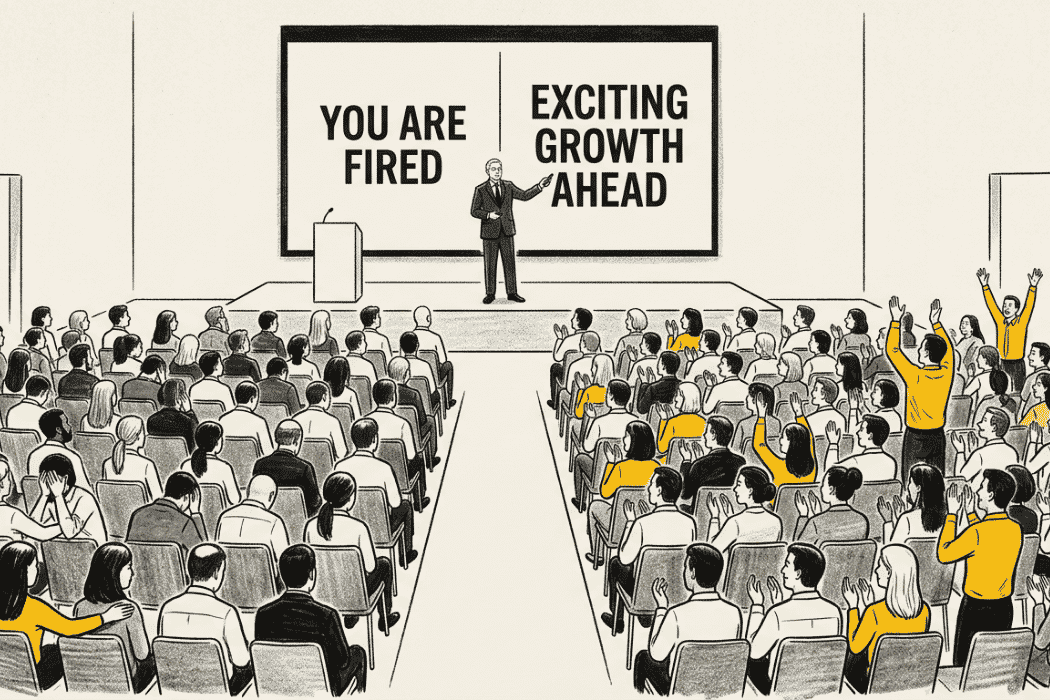
It starts on time. Someone from leadership is on screen, calm, maybe warm. A line about the market. A line about the difficult decision. And somewhere in the next ten minutes, a lot of the people watching learn they no longer have a job.
Then the slides move on. The road ahead. The strategy. The exciting things still to come. All of it delivered to a room that has just been split in two.
Ten years of your life, closed in ten minutes. About the time it takes to join a call, stay on mute, and leave.
1. First, a failure of leadership
Set aside how it was delivered. One fact remains: someone chose to do it this way.
The town hall did not happen to these people. A leader picked the format. A leader approved the script. A leader decided the bad news and the pep talk could share one meeting. That is not an HR process. It is a judgement about people, made at the top.
The tell is the tone. Grief on slide four. Growth on slide five. One face rehearsed for both.
It is possible to tell hundreds of people they are leaving. It is possible, on another day, to talk about ambition and the road ahead. Doing both in the same fifteen minutes, smiling, tells the room where it stood. Not as colleagues being lost. As a line to clear before the good part.
The same companies that spend years calling themselves a family tend to find, when the quarter turns, that families can be restructured too.
The language does a lot of the work. Nobody is fired now. Roles are reduced. Organisations are simplified. Operating models are aligned, as if the model were the thing with a mortgage. You are not losing your job. You are being encouraged to explore the several open roles across the organisation. From home. Against the market. Competing with the version of you that still has one.
Why leaders reach for it is no mystery. One call does the work of a hundred conversations nobody wanted to have. It is legally tidy. And it turns a human event into a communications exercise, run by someone whose badge still works in the morning.
The examples are everywhere. Google held an all-hands days after announcing 12,000 cuts in January 2023, where, CNBC reported, staff had to ask how the names were chosen. The Washington Post's publisher announced layoffs at a town hall and walked out when hands went up, per Poynter. At Vice Media in 2024, Fortune noted, staff answered a layoff town hall with a wall of thumbs-down emojis until the chief executive ended it early.
Sometimes the gathering disappears altogether. Better.com fired around 900 people on a single Zoom call in December 2021, as CBS News reported. This month, by an unverified employee account carried by Indian media, about 80 people on a US fintech's India support team were pulled into a five-minute Google Meet late in their shift and told they were gone.
Different rooms. One instinct. Deliver the worst news at a distance, to a crowd, on a schedule.
Good leaders know that how you end a relationship is the truest thing you ever say about it. The manager who takes the harder path, the real conversation, the plain reason, the willingness to sit in someone's disappointment instead of talking past it, is not being soft. They are being accurate about what a company owes the people who built it.
2. What it does to people, and to the room that stays
People survive hard news. What lands differently is the form.
Being told, among a hundred colleagues, that you are one of the ones leaving. The chat scrolling on while a stranger talks strategy. The silence after the call ends, when there is no one to ask what you did wrong. Because the honest answer is usually nothing, and no one is left on the line to say it.
Then the small mechanical cruelties, all within the hour. The laptop that locks mid-sentence. The badge that stops working. The accounts that go dark.
The message underneath is simple. A relationship of years can be closed in minutes, and no reason was owed.
Here is what companies keep missing. People do not, in the main, resent being laid off. They resent being disappeared.
A layoff with a reason, a name attached to the decision, and someone willing to sit in the discomfort of delivering it, is a hard day. A layoff with none of those is an insult that outlasts the severance.
And it does not stop with the people who leave. Everyone still employed watched how it was done. They drew the obvious conclusion about what they are worth when the numbers turn.
That is the part that shows up months later. In the quiet, careful, half-committed way people work once they have seen the exit handled as an agenda item. A company can cut headcount in a morning. The trust it burns doing it badly takes years to rebuild, and some of it never comes back.
3. The fix, and who can force it
None of this is an argument against layoffs. It is an argument against doing them badly, which costs almost nothing to fix.
Give notice, so the news is not an ambush. Give a reason, specific to the person, or at least honest about the business. Have a named human deliver it in a conversation, not a broadcast. Make the individual calls before any town hall, so no one learns their fate in a crowd. And make the transition help real: extended cover, outplacement, a reference, time.
Companies that do these things are not softer. They have just stopped pretending a town hall is the same as being told.
Where a company will not choose decency, the state still can. On paper, India has a framework for this.
The Industrial Disputes Act treats job cuts as retrenchment. It asks for notice, compensation, and, in larger establishments, the government's prior permission. The catch is who it covers. Those protections attach to a "workman," and companies routinely treat software engineers and data staff as outside that definition. That reading is unsettled at best.
Add no unions, offices structured below the headcount thresholds, and new labour codes only half in force, and the white-collar layoff falls into a space almost no one has to watch. It is the quiet that met the cuts at a global sportswear brand's technology hub in Gurgaon this month. Confirmed by the company, and sitting well outside the machinery that protects a factory floor.
It does not have to be that way. When Ford shut its Chennai plant in 2021, its workers first heard by text message, then struck, and the Tamil Nadu government stepped in. After more than a year and over 68 meetings, the settlement was not fifteen days a year. As Autocar Professional and Business Standard reported, it came to an average of about 140 days of wages for every year served, roughly five years of salary per worker, and in some cases far more.
The difference was not decency. It was standing. The Ford workers were covered, organised, and impossible to ignore. The engineer let go in a ten-minute town hall is, too often, none of those things.
These are people who vote. Who pay their taxes. Who build the companies whose profits are announced a quarter later. The one moment they most need the state to notice them is the moment it looks away.
A country that can broker five years' salary for the workers of a closing car plant can decide that the people cut from a glass tower deserve to be seen too.
Until it does, the town hall will keep doing its work. And the person on the other end will keep closing the laptop, alone, working out how to say it at home.
.jpg)

%20(1).png)

.png)