


Was it an error? Apparently, and that is the reason to worry
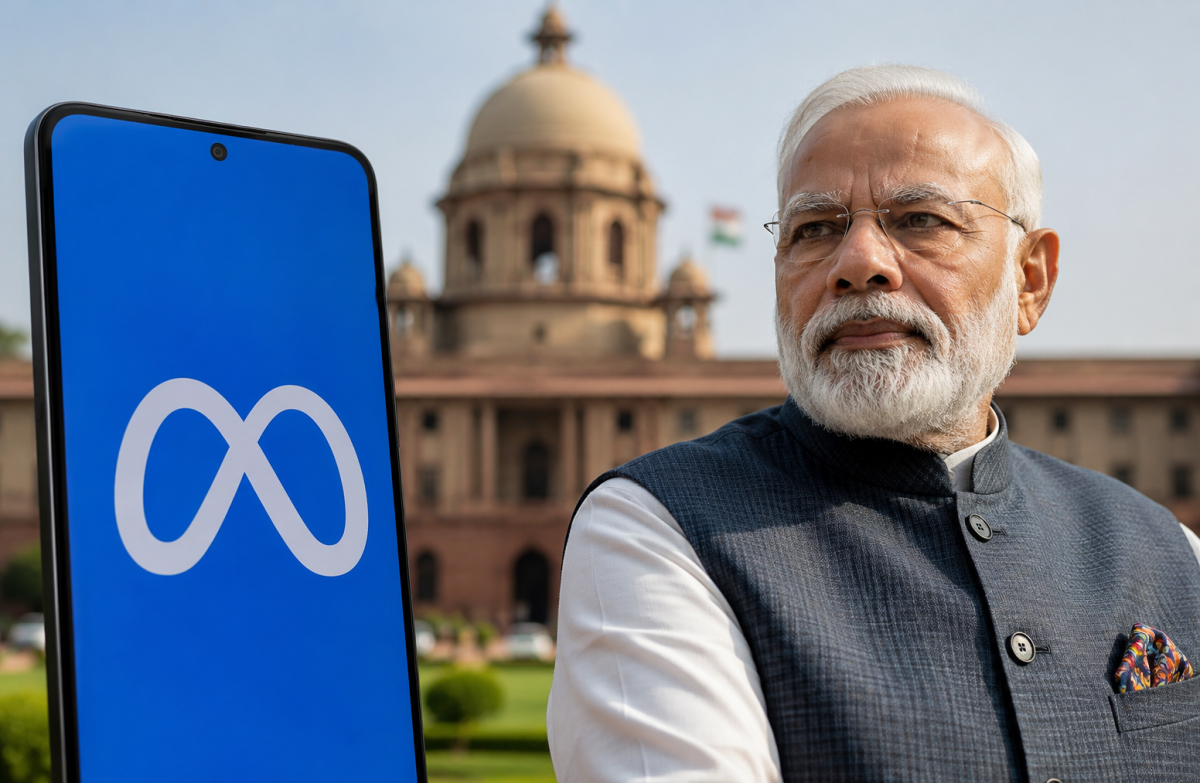
The likeliest explanation is dull. A legal-removal signal, an automated moderation system, a match that should never have fired, and for a few hours the most-followed leader on the platform, Indian Prime Minister, was gone from Facebook. Meta has said as much, and there is little reason to reach for a conspiracy when scale and automation account for it on their own. That is precisely the discomfort. An accident of this size is only possible because the decision about what a billion people can see is now taken by machines running at planetary speed, where a single configured or misconfigured rule can erase a Prime Minister as easily as it erases a common person. The most-viewed reel in the platform's history, more than 300 million views in a day, and a follower count that made Modi the first serving world leader past 105 million, offered no protection at all. Is the error a glitch in the system or a trait of the platform?
Did Meta boost one party and bury another?
In the days after the takedown, a second story travelled through parts of the Indian internet: that Meta had paid to amplify the satirical Cockroach Janta Party while starving the BJP of organic reach. It appeared in some places as apparent fact. It has not been verified by any major outlet, and the careful reporting cuts against it. Government sources say Meta executives admitted in the ministry meeting that significant sums had been paid to boost certain content, but The Siasat Daily reports that admission was offered without elaboration and pertained to child sexual abuse material, not political posts. The CJP itself was a documented organic phenomenon, a Gen Z movement with an AI-generated mascot whose account, by Foreign Policy's account, overtook the BJP's official handle in four days. Notice what has happened. The allegation cannot be proved. It also cannot be disproved. When the ranking system is proprietary, the training data is effectively the open web, and the moderation is automated, bias stops being something anyone can confirm or refute. That is worse than a machine we know to be biased. It is a machine whose bias is unfalsifiable, and unfalsifiable power is the hardest kind to hold to account.
What had happened in 2020 ?
The charge is neither new nor consistent. In 2020 the Trinamool Congress wrote to Mark Zuckerberg accusing Facebook of bias towards the BJP, days before the company's India head was called before a parliamentary panel. Six years later the grievance has flipped, and the same company stands accused of the opposite tilt. A system charged with pro-government bias in one cycle and anti-government bias in the next is telling us something. Either it leans in every direction at once, or it is opaque enough that whoever feels wronged can read their own suspicion into it. Both readings are indictments, and both point at the same missing thing: an auditable account of how the machine decides or can it be biased to decide?. Absent that, every party gets to believe the algorithm is against it, and each is equally unable to prove it.
Who holds the switch now? Two hands, and neither is yours
Watch the response because it reveals where power has settled. The Indian state's answer to a private company's control over the public square was to summon that company's executives, extract a public apology, and remind it that it cannot shelter behind the neutral-intermediary defence written into Section 79 of the IT Act. That is a real lever, and it worked. Meta's Chief Global Affairs Officer, a former Deputy Chief of Staff in the Bush White House, flew to Delhi and apologised across a 45-minute meeting; government sources say the apology came from Zuckerberg too, alongside separate contrition over child sexual abuse material and deepfakes. But look at what the exchange builds rather than what it settles.
Does the platform keeps the switch and the power? The state has demonstrated it can make the switch move on demand. Two unaccountable hands now rest on the same control over what a country sees and says about itself, and the meeting between them reads less like a check on power than a negotiation over who gets to use it. The citizen, and the working professional whose audience and income live inside these apps, is the one party in the room with a hand on nothing.
What does this mean for the future of work?
For a growing class of Indian professionals this is not an abstraction about geopolitics. It is the ground they stand on. The recruiter who sources on LinkedIn, the consultant whose pipeline is a Facebook page, the founder whose launch rides on a single reel, the millions who have turned a following into a living: all of them work inside systems that can make their output invisible without warning, without explanation and without appeal, governed by an automated logic they cannot see and biases they cannot audit.
If the most-followed leader on the platform can be switched off by accident, and can command a global apology to be switched back on, the ordinary professional has neither the visibility to know what happened nor the leverage to reverse it. The lesson of a decade of building on rented land was that reach could vanish.
Does anyone know where this ends?
Probably not, and that may be the most honest thing to say about it.
The systems that now sit between a nation and its own conversation were built to hold attention, not to govern a public square, and they have grown past the point where the people who run them can fully explain their behaviour.
An apology has closed this incident. It has closed none of the questions the incident raised. What happens on the day the switch is thrown and the word 'error' is not offered, and would we be able to tell the difference? For now, a private company can make a country's prime minister disappear for a morning and call it a mistake, and the only reason we are discussing it is that this time, by every available account, it was one.
Sources
- Reuters, 'Meta apologises to India for restricting PM Modi's post', 5 August 2026. Kaplan's statement; MeitY summons; operational-error explanation.
- Bloomberg, 'Meta apologizes to India for restricting Modi's Facebook video post', 5 August 2026. Kaplan-led delegation meeting Technology Minister Ashwini Vaishnaw in Delhi.
- Business Today, 'Meta's Mark Zuckerberg apologised for child abuse, deepfakes, content boosting: Sources', 5 August 2026. 45-minute meeting with IT secretary S Krishnan; reported admission on paid boosting.
- The Siasat Daily, 'Zuckerberg apologises for temporarily removing PM Modi's video', 5 August 2026. Clarification that the paid-boosting admission pertained to child sexual abuse content; neutral-intermediary point.
- Foreign Policy, 'India Cockroach Protests: Gen Z Social Media Tactics Force Modi to Accede', 30 July 2026. CJP as an organic, content-first movement; AI-generated mascot; overtook the BJP handle in four days.
- Reuters, 'Key Indian regional party accuses Facebook of favouring Modi's BJP', 2 September 2020. The 2020 Trinamool Congress complaint.
- BBC (reported), July 2026. Indian government order to remove CSAM-promoting adverts and content on Instagram.
- Moneycontrol and other local outlets (reported), 5 August 2026. Zuckerberg's apology over CSAM, deepfakes and operational lapses.
- Wocult News, 'Meta apologises after restricting PM Modi's viral selfie video on Facebook', 28 July 2026.
- Wocult News, 'Case filed against Meta India head over morphed videos of PM Modi on Facebook', 31 July 2026.
Note on the unverified claim: the assertion that Meta paid to amplify CJP content and suppressed the BJP's organic reach circulated via partisan commentary and social posts. It was not corroborated by Reuters, Bloomberg, the BBC or other major outlets, and is treated in this piece as an unverified allegation, not a finding.
Photo : Hindustan Times
.jpg)
%20(1).png)

.png)