




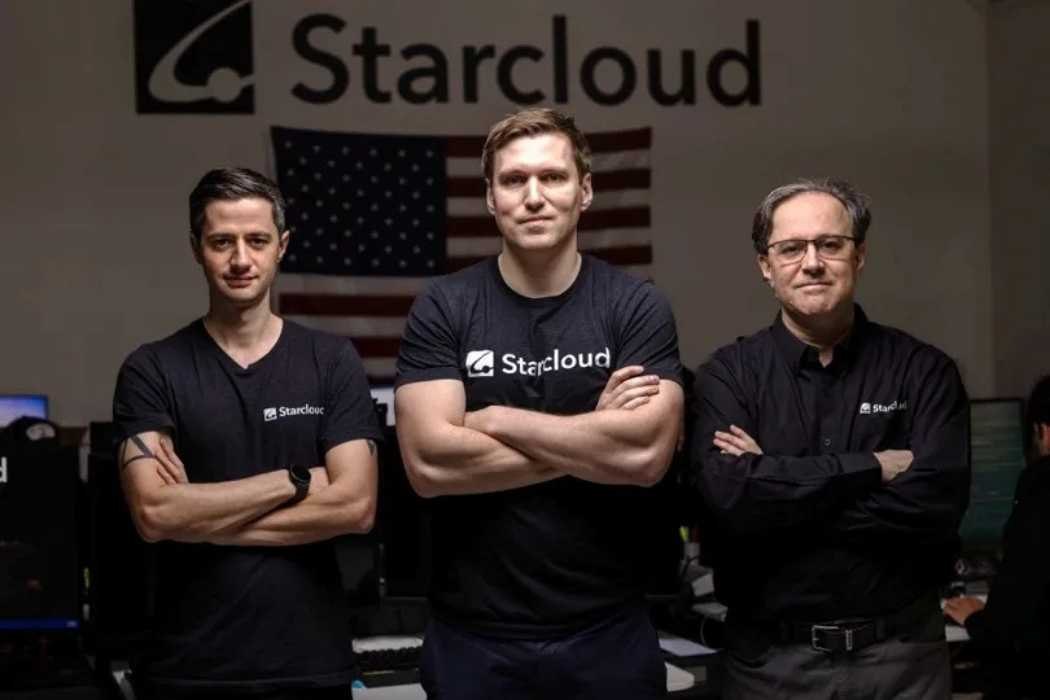
Redmond, Washington-based Starcloud has closed a $250 million Series A extension at a $2.3 billion post-money valuation, less than five months after it was valued at $1.1 billion in a $170 million round in March.
The funding brings Starcloud's total capital raised to $450 million since its founding in 2024.
The round was led by Manhattan West, with participation from existing investors Benchmark, EQT, Soma, NFX, 776, and others, alongside new investors NVIDIA, Cisco Investments, Cedar Capital, Goanna Capital, Standard Capital, and others.
Since launching Starcloud-1, the company says it has trained an AI model in space, operated Google's Gemini in orbit and demonstrated inference and fine-tuning using flight hardware. Starcloud's collaboration with NVIDIA began when the company flew the first NVIDIA H100 GPU to orbit aboard its Starcloud-1 satellite in November 2025, and the two companies are now working together on NVIDIA's Space-1 Vera Rubin Module.
The additional capital will allow the company to open a larger manufacturing facility and advance its largest orbital data center spacecraft, Starcloud-3, which is intended to fly on SpaceX's forthcoming Starship rocket.
Starcloud's long-term plan calls for a constellation of 88,000 satellites providing 20 gigawatts of orbital computing capacity.
CEO Philip Johnston is also amassing capital to ensure he can launch satellites as the market for rocket transportation tightens up, saying: "We can see what's coming, we're going to need to book an enormous amount of launch."
SpaceX's blockbuster IPO has rekindled investor interest in the space industry, including in emerging areas such as orbital data centers. For professionals in cloud infrastructure, hardware engineering and AI systems, the sector is beginning to attract the kind of strategic capital that typically precedes large-scale hiring and supply-chain expansion.