




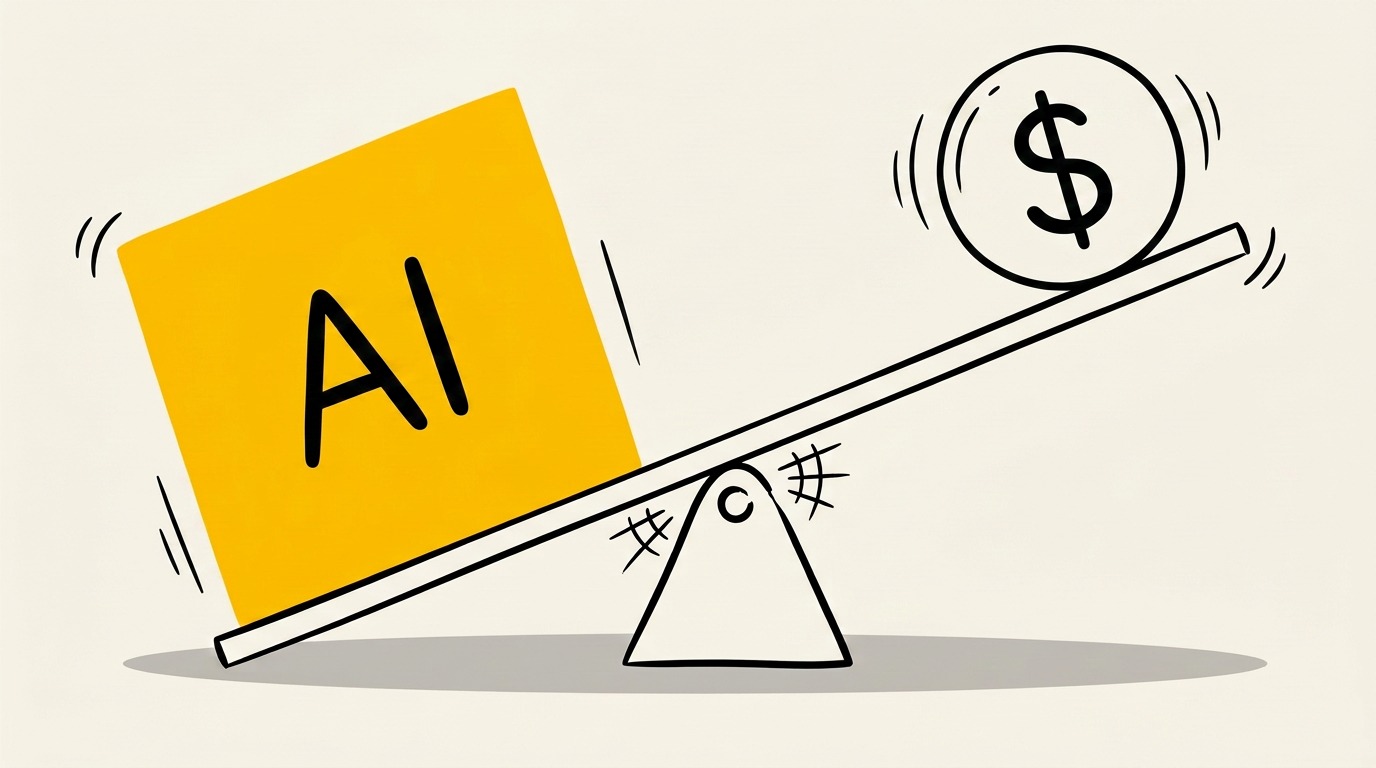
What is actually happening with AI and money
Running a large AI model is expensive in a way ordinary software is not. A normal web app serves you a page that already exists. An AI model builds its answer from scratch every single time, running your request across a vast amount of specialised, power-hungry hardware. There is no cheap, cached version of your reply. And it happens again for the next query, and the next, across hundreds of millions of people. Answering a single AI query can cost many times more than a basic web search.
The companies behind these tools like OpenAI, Google, Anthropic, are spending enormous sums to build and run them, and most of that money is not yet coming back. Where the numbers leak out, they are startling. OpenAI is reported to have earned around $13 billion in 2025 and spent far more than that doing it, and to have signalled compute commitments running into the hundreds of billions of dollars over the coming years. These are not the finances of a settled business. They are the finances of a land grab.
Economists have a name for the problem underneath all this: tokenomics, the difficulty of pricing AI in a way that actually covers what it costs. The trap is simple and vicious. Charge what it really costs, and most people stop using it. Charge less, and you lose money on every query. Give it away, and you build a dependency you will one day have to start charging for. Almost everyone is in that third box right now subsidising your usage, heavily, and hoping to find the business model before the money runs out.
The tool feels free because someone decided, for now, to eat the cost. That decision is not permanent.
Why this matters if you use AI at work
For a working professional in India, this is not an abstract worry about Silicon Valley balance sheets. Think about what you actually use these tools for. The emails. The reports. The document you summarise before a meeting. The quick bit of research. The code. The awkward message you draft twice. If any of that has become part of your daily rhythm, you have quietly taken on a dependency that sits on a foundation nobody has made stable yet.
The risk isn't that AI switches off one morning. It's slower, and harder to see coming. Free tiers move behind paywalls. Features that feel standard get sorted into expensive plans. The usage limits that look generous today tighten as companies start caring about cost. And the smaller tools which are the clever ones built by startups on top of the big models, are the most fragile of all: when their funding runs out, or the API bills they can't control climb too high, they simply close.
If your employer pays for your AI, you might feel insulated. Not entirely. Which tools stay approved, which get cut in the next budget review, which teams keep access while others lose it and those decisions are already being drafted. The people who handle this best are the ones thinking about it before it lands on them.
The larger pattern: reshape the work, then charge for it
We have seen this arc before. Cloud storage started generous and quietly tightened. Software that replaced the old way of working became too expensive to leave once you were inside it. Platforms that once felt open began charging for things that used to be free. The playbook is familiar: make yourself essential first, price it properly later.
AI is running the same arc, faster, and with higher stakes because of what these tools actually do. Cloud storage held your files. AI, for a lot of people, is doing parts of the job itself: the writing, the thinking, the first draft of the analysis. That is a far deeper dependency, and a far stronger hand for the company that owns the tool when it decides the free period is over.
The bill: your own capability
There is a second cost, harder to see than the financial one.
If you have handed real parts of your thinking, writing and research to a tool, what happens to your own ability to do those things when the tool gets expensive, or gated? A muscle you stop using gets weaker. The question isn't whether AI makes you faster today, it plainly does. It's whether, underneath the speed, you are keeping the capability to work without it. Worth sitting with as a reason to stay awake to how you lean on them.
The India cut: the equaliser could reverse
For large and stable companies, this whole story is simple : costs rise, prices follow, and the subscription gets absorbed alongside every other one. They will be fine.
It gets complicated for the people who had the least to begin with like freelancers, small teams, early-career professionals, anyone working without a big budget behind them. Because for them, AI has been an equaliser. It let one person produce work that used to need a team, or an expensive specialist. It lowered the barrier to doing serious, sophisticated work and a young, ambitious Indian workforce walked straight through that open door.
An advantage that was briefly available to everyone becomes, again, something you buy.
If access starts sorting itself by what you can pay, that equalising effect goes into reverse. The tokenomics problem stops being a funding question in California and becomes a local one: who gets to keep these tools as they get expensive, who gets priced out, and how wide the gap grows between the two.
What to do while it's still cheap
None of this is a reason to stop using AI. It's a reason to use it with your eyes open, while the tools are still generous.
Know which tools are load-bearing, the ones your work would genuinely struggle without and assume their price will rise; favour the ones you'd be willing to pay for over the ones that only make sense while free. Don't build a workflow you couldn't run, slower, on your own if you had to. Keep your core skills warm: write the hard thing yourself sometimes, think a problem through before you hand it over. And treat anything a small startup offers for free as temporary by default. The goal isn't to hoard skills against a machine. It's to make sure that when the price is set honestly, you're choosing AI not trapped by it.
The question worth sitting with
The bill for AI is going to arrive. The only open questions are when, in what form, and who ends up holding it. So it's worth getting ahead of one of them now, while the tools are still cheap.
Sources
- BBC News : On the cost of AI queries and the "tokenomics" challenge.
- Reuters (via Yahoo Finance) : OpenAI's projected compute spend of around $600 billion through 2030.
- The Information (via TechSpot) : OpenAI's 2025 revenue (~$13 billion) against far higher spending.
.jpg)


%20(1).png)

.png)