






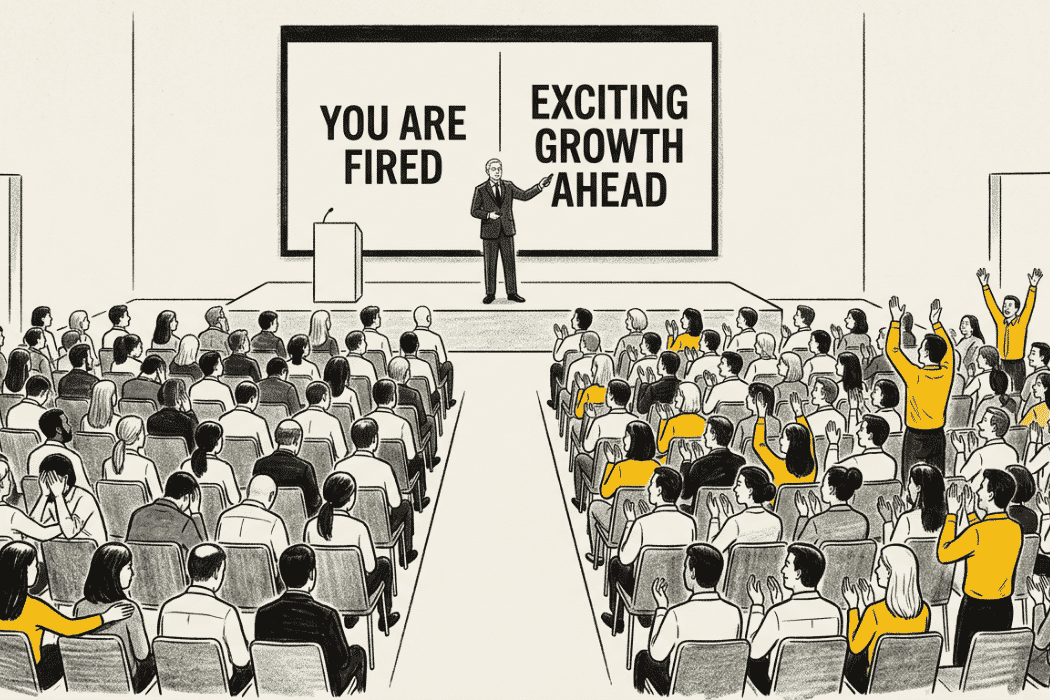
AI is not firing India's professionals. It is hiring fewer of the people who would have replaced them, and the cost falls on graduates who need a first job to learn on.
India's job market does not look broken. White-collar hiring rose 14 per cent in October, and demand for AI specialists is growing faster than almost any other category. One level down, the picture changes. In a survey of 651 Indian IT firms, 55 per cent said junior-level employment had fallen since they adopted AI. The work that used to train a 22-year-old is increasingly done by software, and the first rung of the career ladder is narrowing.
Is AI taking jobs in India?
Not in the way the headlines feared. The clearest evidence so far comes from the Indian Council for Research on International Economic Relations (ICRIER), which surveyed 651 IT firms across 10 cities between November 2025 and January 2026. Its report, 'AI and Jobs: This Time is No Different', supported by OpenAI, found no collapse in overall employment. It found a change in shape.
Sixty-five per cent of firms said hiring had slowed after they introduced AI tools. At the junior level, 55 per cent reported falling employment and 35 per cent a rise. At the mid level the balance tipped the other way: 42 per cent were hiring more and 25 per cent fewer. At the senior level, 82 per cent reported no change at all.
Read together, those numbers describe an industry that is keeping its experienced people, competing for specialists and taking on fewer beginners. That is not a layoff. It is a decision, made across thousands of hiring plans, not to replace the bottom of the pyramid.
Why does the first rung matter more than a layoff?
Because the first job is where professionals are made. For three decades, Indian IT ran on a simple model: hire graduates in large numbers, train them on routine work, and promote the ones who learned fastest. Testing, documentation, maintenance and first-draft code were not glamorous, but they were the classroom.
That classroom is where generative AI is strongest. ICRIER's respondents named application developers, database designers, software developers, and statisticians and mathematicians among the most exposed roles, with close to two-thirds classing them as significantly exposed. The tasks that taught a 22-year-old the job are the tasks a model now drafts in seconds.
A layoff is visible. It has a date, a number and a news cycle. A first rung that narrows has none of those. The people it affects never appear on a company's headcount at all.
Why does the hiring data still look healthy?
Because the growth is happening in different places. Naukri's JobSpeak Index rose 14 per cent year on year in October 2026, against a base softened by Diwali falling in October 2025. Fresher hiring on the index rose 15 per cent. The detail matters more than the headline. AI and machine learning roles grew 32 per cent and hiring by global capability centres 18 per cent. IT and software services grew 5 per cent. Software engineering and quality assurance roles across industries grew 1 per cent. Hiring for professionals with more than 13 years of experience rose 22 per cent, faster than for freshers.
The two sources measure different things. Naukri tracks job postings and recruiter searches across every sector, from manufacturing to banking. ICRIER asked IT firms what happened to their own payrolls. Together they describe a market where entry-level openings still exist, but the specific first job that built India's software middle class is under the most pressure.
What has happened in the West?
In the United States, the shift is already visible in unemployment data. Writing in The Atlantic in February, Annie Lowrey noted that Americans with a bachelor's degree now make up a record quarter of the unemployed, and that high-school graduates are finding work faster than university graduates, a reversal without precedent. Her wider argument is that if AI removes white-collar work quickly, governments will face a structural problem rather than a cyclical one. No stimulus makes a company want back skills it no longer needs.
India is not there. Its graduates still find work, and much of its AI adoption is still experimental. But NITI Aayog's own worst-case scenario, cited by ThePrint, has IT services headcount falling from 7.5 to 8 million in 2023 to 6 million by 2031. The country's most important white-collar employer has started modelling a smaller workforce.
What does a narrower first rung cost a generation?
It costs years, not months. Research on graduates who enter the labour market in a downturn, cited by Lowrey, finds lower earnings that persist for a decade or more. A first job delayed is a career that starts later and climbs from a lower base.
The Indian numbers were thin before AI arrived. Entry-level salaries moved from about Rs 3.5 lakh a year to Rs 3.8 lakh between 2015 and 2024, according to TeamLease data cited by ThePrint, a nominal rise of less than 9 per cent in nine years. Employers' intent to hire freshers fell to 14 per cent in 2025 from 18.8 per cent a year earlier. The official Periodic Labour Force Survey put unemployment among 15 to 29-year-olds at 15.9 per cent in April to June 2026, the highest in its revised quarterly series.
Who will train the specialists India says it cannot find?
That is the question the industry has not answered. ICRIER found demand rising fastest for mid-level professionals and for hybrid skills, with 63 per cent of firms reporting more demand for people who combine domain expertise with AI or data skills. Only 4 per cent of firms had trained more than half their workforce in AI.
Every mid-level specialist a company wants to hire in 2031 is a graduate it needed to hire in 2026. A firm that stops taking juniors is not saving money. It is borrowing from its own future, and expecting someone else to repay the loan.
The ladder still stands. The question is who gets to climb it.
Sources
- ICRIER, 'AI and Jobs: This Time is No Different', reported by Storyboard18, 16 February 2026
- Outlook Business on the ICRIER report, hybrid-skill demand
- Naukri JobSpeak, October 2026, reported by Lapaas Voice, 3 November 2026
- Annie Lowrey, 'The Worst-Case Future for White-Collar Workers', The Atlantic, 18 February 2026
- Saurabh Mukherjea and Nandita Rajhansa, ThePrint, 28 April 2026 (NITI Aayog and TeamLease figures)
- The Policy Edge on the PLFS Quarterly Bulletin, April to June 2026










Join the conversation
Share your thoughts on this story.