





We spoke to Asma Lata, who has sat on the other side of that table for years, taking people off the list when she wasn't convinced they belonged there, and leading fourteen organisational changes about how to tell a real plan from a paper trail, who actually carries the blame when someone underperforms, and what she tells an employee who has just been handed one.
Before the mechanics, how do you think about fairness itself when it comes to reviews and PIPs?
Fairness is a perception. It varies from person to person and situation to situation. What seems fair to one person can seem unfair to another. Fairness is a feeling, though many people look at it through a purely cognitive lens. The sense of being treated “unfairly” often kicks in when someone is unwilling to accept something. It can also kick in when a person feels they are better than the outcome suggests and are being targeted. It can range from bitterness to pain to a feeling of helplessness.
Performance reviews are scary. They stir up the feeling of being judged. The review is a tangible process, and going through it is an emotional experience for both the people leader and the employee and many people don't see that side of it. HR is responsible for running the process, and in most places it is treated as a rhythm, a duty, a piece of work to be completed.
The trick is to prepare people leaders and employees throughout the year. But with everything already on everyone's plate : the business people leader's, the employee's, HR's, most don't seem to find the time. So it gets reduced to a check mark. That is exactly why timely feedback, and feedforward, at regular intervals matters so much.
Span of control also matters. When a people leader has a smaller team, it's easier. When the span of control is broad, it becomes difficult and we are humanly limited. When those periodic conversations do happen, the employee knows where they stand; they can improve and feel positive about it.
But there is a catch: the bell curve. So who goes to the bottom? How do you genuinely raise the bar without feeling you're living in a boxing ring for your entire stint in the organisation? It's deep and complex, and there is no linear formula for that paradox.

As for improvement plans: a PIP is a good glass, but a stained one. As a tool for improvement it is genuinely useful, but it has too often earned the reputation of being the thing that shows you the door. It's stained because it is a formal document that can be produced as evidence if needed.
The moment an HR business partner learns that an employee may be heading into that zone, I encourage them to get into the case and look deeply. What happened during hiring, why was this person hired? What happened at confirmation, why were they confirmed? Or, if they've been here for years, why did the performance dip? Get into the story behind the scene. Find a way to talk to the employee and understand their side.

And even if you didn't, how are you taking responsibility for the case now or are you using HR and process to hide behind? I hold the people leader responsible. Many times I've asked the HR partner for an explanation, with a whole string of questions, before I sign off on the document.
Let's name it plainly: when is a PIP a genuine attempt to help someone improve, and when is it a paper trail built to fire them? How do you tell them apart from inside the room?
There are two very different situations, and from inside the room they feel different.
A genuine attempt: the people leader is frustrated but still invested. The conversation is about enablement. The milestones are clear, realistic and behavioural, “we need the monthly reports by the 5th, with zero errors.” And the company puts real support behind it: a mentor, specific training, or a temporary reduction in workload to help the person find their feet.
A paper trail: in the room, the people leader is disengaged and HR is doing most of the talking. The goals are vague, or the goalposts keep moving. The people leader has already begun interviewing replacements, or shifting the person's critical projects to other team members. The decision to terminate has effectively been made; the PIP is just legal insulation. And the employee usually senses it too, they've often already started looking.

In corporate performance reviews, how much of a rating is actual performance, and how much is politics, proximity, nepotism and whether your People Leader likes you?
It is very difficult to put a number on it. Quantifying bias as a percentage is nearly impossible, because human bias is present and everywhere. The real question is one of threshold: at what point does bias turn toxic?
When performance management fails, it is rarely because of poor design. It fails because both the people leader and the employee treat the process as an administrative tick-mark. If goals aren't explicitly stated, communicated and measured early, subjectivity fills the vacuum. Isolated instances of bias are hard to detect, but a pattern always emerges over time, it shows up in performance analysis, in employee surveys, in feedback systems and on the grapevine. What cannot be seen cannot be rewarded; that is the basic assumption behind any performance and reward system.
Somehow, the glitter wears off and they are usually the first to leave once they know it's wearing off. Employees are smart, too. They know how to play their cards with each people leader; it takes two hands to clap. The ones who believe “my work will speak for itself” and stay quiet, assuming they'll be noticed, are often the ones who suffer. Work is work unless you're on a high-stakes project, it won't be noticed until you make it visible. And then there are the people who don't have much substance but plenty of glitter.

The research is damning: by the “idiosyncratic rater effect,” 62% of a rating reflects the rater's own tendencies, not the person being rated; Gallup found only 14% of employees say reviews inspire them to improve. If the system is that broken, would you scrap the annual review altogether and if you rebuilt performance management from scratch, what would you keep and what would you throw out?
Organisations need performance management because they need predictability, accountability and documentation for compensation and audits. If you scrap the annual review, the business still needs a way to identify high potentials and address underperformance. Employees don't actually hate feedback. They hate being ranked and stamped like numbers on a spreadsheet. From their side, the annual review can feel like a post-mortem of mistakes they can no longer fix.

Any HR system or process has to be seen in a business context. These are not standalone tools; they are living ones, meant to help the organisation and its people grow. The question is how to keep the concept relevant to the business as it is today, and for the near future. The choice of process also depends on the vastness of the business and the different types of business hosted inside the same organisation, sometimes you need different systems for different ones, sometimes a single system that captures what's unique to each. Both have pros and cons. Underneath all of it, a vital question: what behaviours are we reinforcing? That is the “how” behind the “what” (the targets, the goals), so how much weightage goes to the “what”, and how much to the “how”? A few specifics:
- If you use a rating scale, say 1 to 5, how well is each level defined, the “whats” and the behaviours (the “hows”)?
- Ask whether you still need forced distribution. I've heard stories from other companies where People Leaders hand out the top and bottom brackets by rotation. Ridiculous.
- People Leaders at all levels need to be trained, re-trained and re-re-retrained or reminded some other way, until they become aware of their own biases. So does HR: how do I manage my own reactions, motivate both the high performer and the low one, and have the right conversations? What bias did I just notice in myself?
- The more senior a People Leader gets, the more the biased behaviour gets noticed and, barring a few, the less open they are to reflection, improvement or correction.
- Decouple rating from compensation. It's a bold move, and it needs a certain maturity.
- Doing away with ratings completely is an even bolder move, it asks for maturity from People Leaders, employees and the organisation alike. Then a lot rests on budget management.
- Lean on feedforward at regular intervals. Ask people: what's going well? What isn't? What have you learnt? What would you change? If you had to do one thing differently, what would it be? Just one or two points, at short intervals, so the employee can take small bites rather than face a full load at the end of the year. And of course, listen to feedback from stakeholders; it gives far better insight.

Bias hides easily inside a rating. Who gets judged more harshly : women, older employees, people returning from a break, those who don't self-promote?
It's hard to name a single group because it depends on how the top leadership behaves and whether they instil a real sense of inclusiveness through their personal conduct. I know that can sound distant or philosophical, but nothing operates in a vacuum. I've hired women despite pregnancy, promoted them while on maternity leave because they had done well before the break and were ready for the next role. The honest test is what the data shows during and after the appraisal cycle. A few pointers reveal how an organisation actually thinks:
- When was the last time they hired a pregnant woman?
- How do the women in senior leadership actually feel and what is the silent “payback”?
- How are minorities treated, and how do they feel?
- What are the performance trends for employees close to retirement?
- What happens to women and employees returning from a break: their performance, and their promotions?
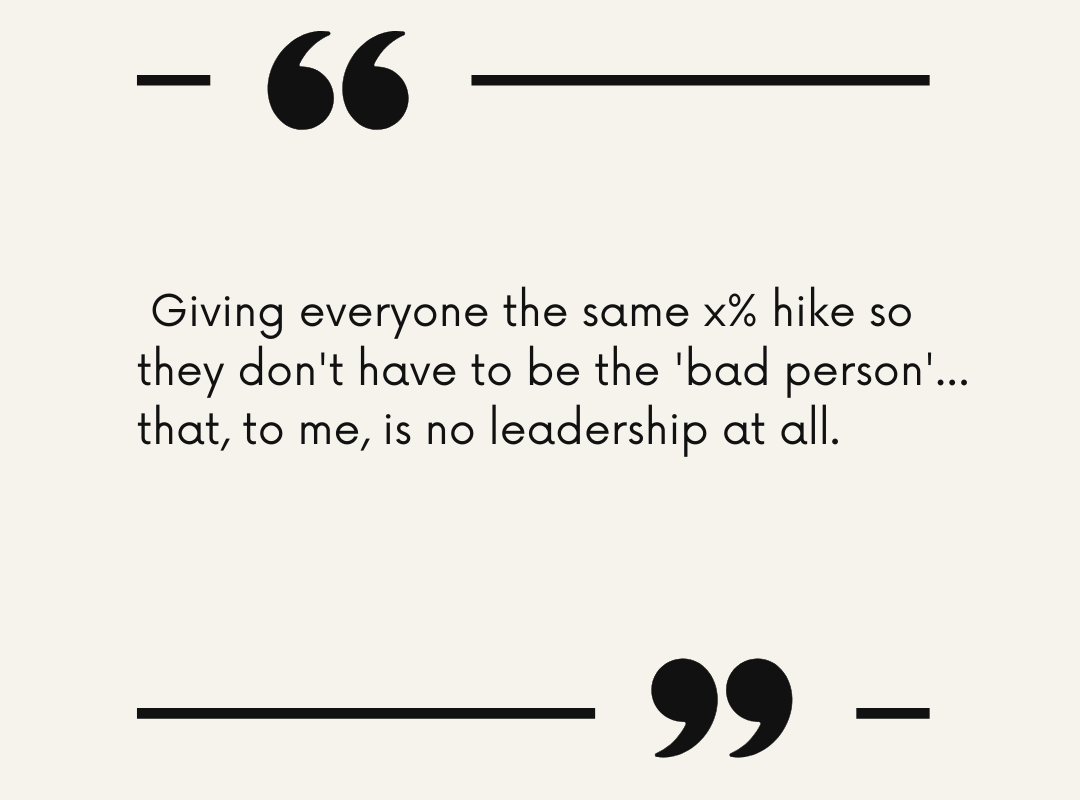
What's the most unfair review or PIP you've watched happen and were you ever in a position where you couldn't stop it? What did that cost you?
It's my firm belief that I've reviewed cases and taken people off the list when I wasn't convinced they belonged there. And when I've seen People Leaders avoiding a PIP that was actually warranted, I've encouraged them to go ahead with it. Fairness isn't only about being fair to the employee. It's also about being fair to the organisation.
What's the honest conversation leaders and HR should be having about reviews and PIPs that almost none of them are willing to have out loud?
It comes down to a few questions a people leader should be willing to ask themselves. Do you take responsibility for your employee before you take any decision about them? Have you removed the narrative in your head before listing them? Have you sincerely tried? Have you had honest conversations? And how much of this is really a People Leader issue, dressed up as an employee one?
I've had people leaders willing to bite the bullet and say, “I'm taking responsibility for my employee. He will perform. Give me three months.” In those cases, I've watched the employee come out of the PIP. Those are the happy days.
For someone who's just been handed an unfair review or put on a PIP right now, and is wondering if it's the beginning of the end, what's the one honest thing you'd tell them?
Start with one question: do you trust your people leader? If you do, then believe in the process. If you don't, there's no sense wasting your energy trying to prove them wrong unless you simply need to prove yourself right. During the conversation, be clear about what you need. What support do you require from your people leader and the company to turn this around? And if you need some time to think, ask for it. And don't just sign off on a document unless you genuinely understand it.

About Asma Lata
Asma Lata is a seasoned Executive Coach, Freelance CHRO and Transformation Advisor with over 28 years of HR leadership across diverse sectors, including engineering, technology, finance and manufacturing. Most recently she led the People and Organization function for an MNC in India and played a global role in a culture-development project. She specialises in organisational growth, culture integration and strategic change, having guided a number of transformations including restructurings, M&As, and scaling headcount in growth projects. Combining credentials in Law (LLB) and HR Management (MHRDM) with advanced certifications in Organization Development (TISS) and NeuroLeadership, she fuses neuroscience with human-process work, coaching executives and designing high-impact leadership programmes.


%20(1).png)

.png)