



The walk-back
Sam Altman told a Commonwealth Bank conference he was "pretty wrong" on AI's economic impact and "delighted to be wrong" about entry-level job losses.
Jensen Huang took direct aim at fellow executives who publicly blamed AI for workforce reductions. "The narrative that connects AI to job loss, for many of the CEOs that are doing it : it is just too lazy," he said. "AI has just arrived. How is it possible they're already losing jobs?"
Huang went further: "How is it possible that AI became productive and useful only six months ago, and they were somehow laying people off two years ago because of AI?"
This is a remarkable statement. Because the layoffs happened. They are documented. And in many cases, the companies conducting them including companies in Huang's own ecosystem , cited AI as the justification.
What actually happened while they were warning
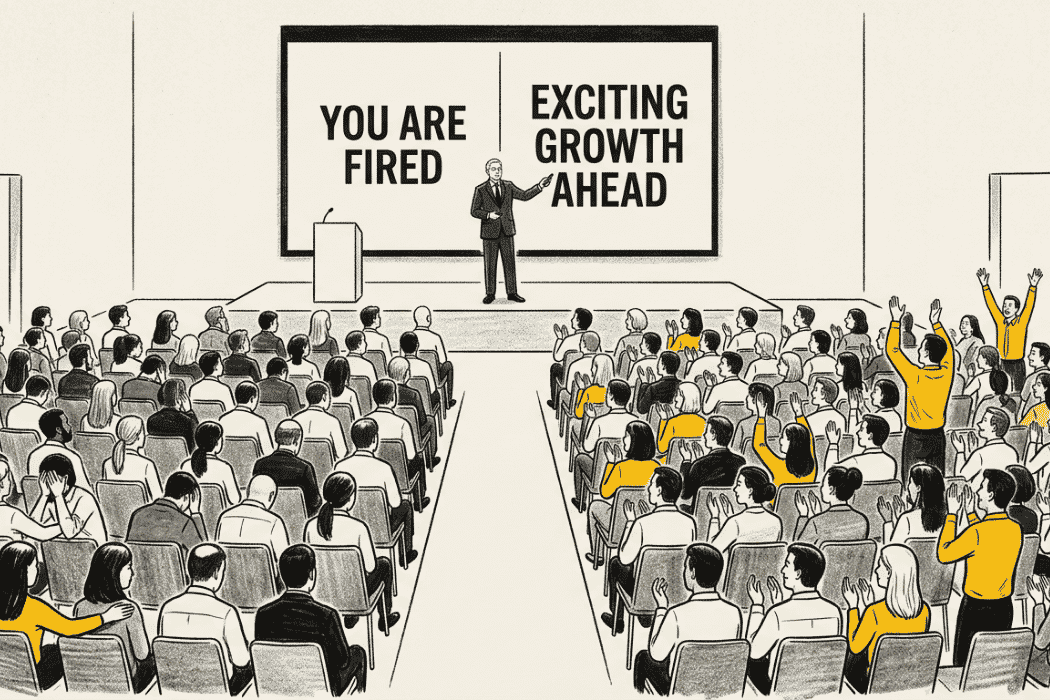
Tech layoffs through May 2026 have passed 115,000, already approaching the 124,000 logged in all of 2025. Meta eliminated roughly 8,000 roles this month alone, about 10% of its workforce, citing AI as justification. Intuit cut 3,000 people. AI has been cited for nearly 50,000 job cuts through April 2026, according to outplacement firm Challenger, Gray & Christmas.
The warnings created the conditions. The layoffs followed. Customer service teams were cut as chatbots took over. Content roles disappeared. Administrative positions vanished. Each announcement referenced AI capabilities and efficiency gains using the exact language that Altman, Amodei, and others had spent months inserting into the public conversation.
And here is the data paradox that makes this story genuinely uncomfortable: the Yale Budget Lab has found no significant changes in occupational mix or unemployment duration in high-AI-exposure jobs since ChatGPT launched in late 2022. The jobs apocalypse has not materialised in the labour market data. But 115,000 tech workers have still lost their jobs this year, with AI cited as the reason.
So which is it? AI is disrupting work enough to justify cutting 115,000 people but not enough to show up in occupational data? The narrative and the numbers are not resolving cleanly. And the people most responsible for the narrative are now distancing themselves from it.
The timing that matters
The reversals from Altman and Amodei come as their companies — OpenAI and Anthropic — are expected to embark on high-profile IPOs that will require broad buy-in from investors to succeed.
OpenAI completed a Series C funding round on March 31, 2026, at a post-money valuation of approximately $852 billion, and multiple reports indicate the company is preparing to file for a public listing as early as September 2026. Anthropic, valued at roughly $380 billion in its most recent private round, is also reported to be preparing a late-2026 listing. Earlier doom-laden statements have come to haunt the AI industry as the public voices serious discontent in polling over the disruption that tech companies and political leaders predict from AI.
Public hostility to AI job displacement is bad for IPO valuations. A reassuring narrative is better. The timing of the walk-back and the timing of the IPO preparation are not unrelated.
Peter Wildeford, Head of Policy at the AI Policy Network, said: "It's hard to say whether they've actually changed their forecasts for AI's economic impact, or whether they're just trying to change the narrative."
What this means for the professional reading this
The whiplash is not just a communications problem. It has real consequences for the people whose careers were shaped by the original warnings and for the people whose jobs were eliminated using those warnings as cover. Many professionals who survived layoffs now work with skeleton crews, picking up responsibilities from eliminated roles while companies experiment with AI replacements. The promised efficiency gains often prove incomplete. Human workers bridge the gaps. The institutional knowledge lost in the cuts proves harder to recover than the cost savings justified.
The lesson is not that AI is harmless. The data on that is genuinely mixed and the picture will keep evolving. The lesson is something more uncomfortable: that the people building AI have a commercial interest in the narrative around AI and that narrative shifts to serve that interest, not to serve yours. When they said jobs were at risk, it served the interest of positioning AI as powerful, urgent, and worth investing in. When they say jobs are safe, it serves the interest of an IPO that needs public trust.
Both statements cannot be fully true. The professionals who have already lost jobs to AI-cited layoffs know which version they lived.
The question
The AI leaders who built the apocalypse narrative and the AI leaders walking it back are largely the same people. The workers who lost jobs while that narrative was in circulation are not walking anything back. Their experience does not get a revision. Healthy scepticism about corporate communications, especially from companies with trillion-dollar valuations and imminent IPOs, is not cynicism. It is the most rational response available to a professional trying to make career decisions in a landscape where the people shaping the narrative have significant financial stakes in what you believe.
The question is not whether AI will change your job. It definitely will. The question is whose version of that change you are going to trust and what they stand to gain from you believing it.
Sources
BNN Bloomberg — AI chiefs walk back job apocalypse warnings, May 27, 2026
Fortune — Sam Altman and Dario Amodei walking back AI jobs apocalypse prophecies, May 26, 2026
Time — Sam Altman says AI jobs apocalypse probably won't happen, May 26, 2026
MLQ.ai — Altman and Amodei walk back AI job apocalypse warnings ahead of trillion-dollar IPOs, May 27, 2026
France 24 — AI leaders soften warnings on job losses, May 28, 2026
Challenger, Gray & Christmas — AI-cited job cuts data, April 2026
Yale Budget Lab — AI labor market impact tracker, March 2026
Layoffs.fyi — Tech layoff data, May 2026
.jpg)


%20(1).png)

.png)