





This is the paradox worth sitting with. The cities that pay the best salaries, offer the best jobs and absorb the most ambitious people are producing a population that is materially rich and psychologically depleted. We propose a name for this condition: modern poverty.
What is modern poverty?
Modern poverty is not the absence of income. It is the absence of the life that income was supposed to buy. It describes the professional who earns in the top decile of the country and cannot point to a single weekday hour that belongs to them. It is measured not in rupees but in deficits of time, sleep, attention and connection. The old poverty emptied the wallet. The new one empties the person while the wallet stays full.
The data supports the diagnosis. The National Mental Health Survey found that mental health morbidity in urban metros stands at 13.5 per cent, nearly double the 6.9 per cent recorded in rural areas. The same survey found the prevalence of common mental disorders, including depression and anxiety, was highest among people living in metros. In other words, the geography of India's wealth and the geography of its psychological distress are the same map.
The workplace numbers sharpen the picture. A 2024 CII and MediBuddy report found that 62 per cent of Indian employees experience burnout, against a global average of about 20 per cent. India's professionals are not merely tired at rates comparable to their global peers. They are exhausted at three times the rate, in the very cities that the consumption data celebrates.
How much does it cost to look successful?
Here is the part the salary negotiation never covers. The metro does not just pay you more. It charges you more to remain eligible for the paycheque, and then charges you again to look like someone who earns it.
Start with rent. Housing in the six cities has become the single largest claim on the urban professional's income, and the pressure is compounding. Average residential prices across India's top seven cities rose roughly 50 per cent between 2023 and 2025. Rents in the most sought-after job corridors have climbed in step, which means a promotion in Bengaluru or Gurugram often changes the landlord's income more than the tenant's.
Then comes the EMI. The Reserve Bank of India's Financial Stability Report shows per capita household debt rose from around Rs 3.9 lakh in 2023 to Rs 4.8 lakh by March 2025, a 23 per cent jump in two years. Household debt now stands at over 42 per cent of GDP, up from under 37 per cent in 2021. The more telling detail sits inside those numbers: the RBI notes that borrowing is increasingly directed towards consumption rather than asset creation. Indians are not just borrowing to build. They are borrowing to be.
The instalment has become the operating system of metro life. The flat is an EMI. The car, upgraded to match the designation, is an EMI. The phone, the furniture, the holiday and the wedding are EMIs. Each instalment is individually rational. Collectively, they convert a high income into a pre-committed one, where the money is spent before it arrives and the professional is working, in effect, for a queue of lenders.
And then there is the most elegant trap of all: the premium credit card. The metro professional is now courted with metal cards carrying annual fees that run from ten thousand rupees to well past fifty thousand, sold not as credit instruments but as identity documents. Airport lounge access, golf privileges, concierge lines and milestone rewards are designed to make the fee feel like membership rather than cost. But the economics of these cards run on a quiet mechanism: the fee waiver and the reward tier are tied to annual spend thresholds, which means the card does not reward what you were going to spend anyway. It sets a target. The professional chasing a Rs 8 lakh or Rs 10 lakh annual spend to justify the fee is no longer using credit. Credit is using them, converting status anxiety into a minimum spending obligation with a due date. It is the only poverty in history that comes with priority boarding.
Beneath the marketing, the strain is visible in the system. Credit card debt has surged alongside other unsecured lending, with defaults ticking upward, and the central bank has repeatedly moved to cool the segment. The card that was meant to signal arrival has become, for a growing number of its holders, revolving debt at some of the highest interest rates in formal finance.
This is the engine room of modern poverty. Debt does not merely reduce disposable income. It disposes of freedom. The professional servicing five EMIs cannot take the sabbatical, cannot risk the career change, cannot afford the month of unemployment that walking away from a toxic workplace would require. The salary is high, but it is also a leash. And the anxiety is not abstract: financial strain is a well-documented driver of chronic stress, sleeplessness and depressive symptoms, and India's Economic Survey has now explicitly linked mental ill-health to national productivity losses.
Why does prosperity fail to convert into wellbeing?
Part of the answer is arithmetic. Metro salaries are high, but so is the toll the metro extracts to earn them. Rent, commutes, instalments and the rising cost of simply participating in city life absorb both money and hours. A two-hour daily commute is a tax of roughly 500 hours a year, paid in the currency that matters most and cannot be earned back.
Part of the answer is comparison. The six cities of the PRICE and Tata Sons report are not just consumption hubs. They are proximity machines, placing every professional within daily sight of someone earning more, living better and apparently coping. Income satisfies in absolute terms. Status dissatisfies in relative ones, and the metro manufactures relativity at industrial scale. The luxury car on EMI is rarely a transport decision. It is a defence against the question of what the neighbour drives.
And part of the answer is what economists politely call thin social infrastructure. Migration built these cities, and migration has a cost that never appears in a payslip: distance from family, friendships that must be rebuilt from zero, and a social life that competes with a ten-hour workday and usually loses. The National Mental Health Survey found a treatment gap of over 80 per cent for common mental disorders, meaning the vast majority of those struggling receive no professional care at all. In the metros, the professional class often substitutes endurance for treatment and calls it resilience.
The uncomfortable conclusion
None of this is an argument against the city, or against ambition. The six-city economy is real, and it will keep pulling talent towards it because that is where the work is. The argument is against the accounting. A country that measures its cities only by what they consume will keep mistaking exhaustion for success, and mistaking leverage for wealth.
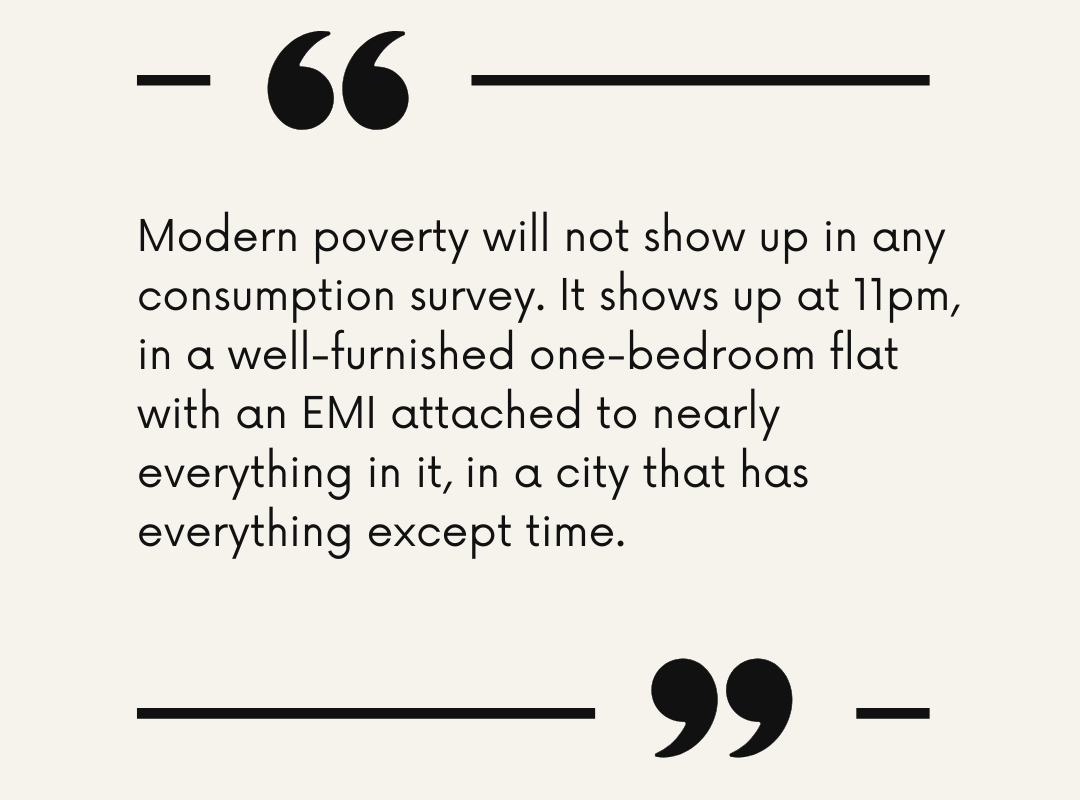
The consumption data, the debt data and the mental health data are three entries in a single ledger. India's metros are running a surplus on one side and a deficit on the other two, and the deficit is being carried, silently and personally, by the working professional. Modern poverty will not show up in any consumption survey. It shows up at 11pm, in a well-furnished one-bedroom flat with an EMI attached to nearly everything in it, in a city that has everything except time.
Work should feel good. In the richest cities in India, for too many people, it does not. That gap is the story of this decade.
.jpg)

%20(1).png)

.png)