


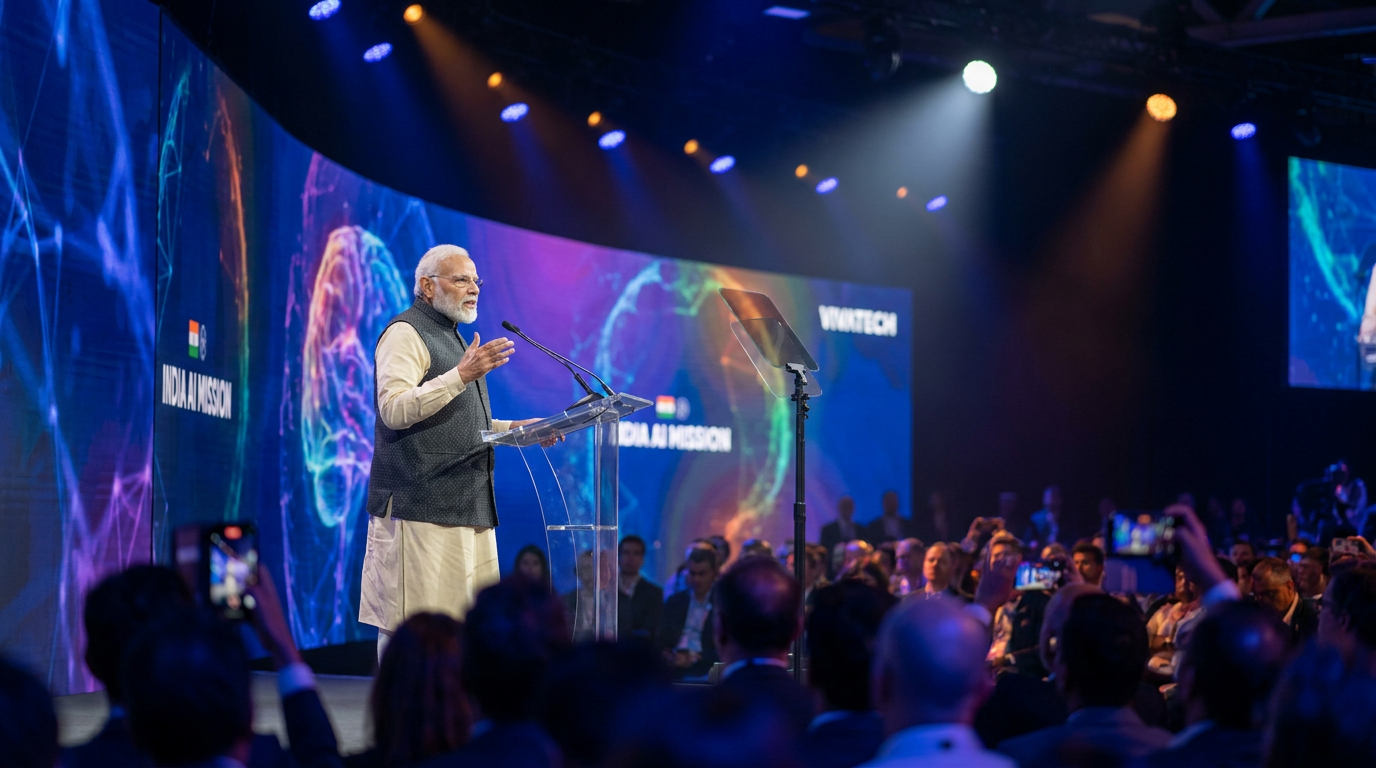
The speech was ambitious. Modi announced targeted incentives exceeding $50 billion to back private enterprises from the innovation stage through to commercialisation, extending an invitation to global technology leaders to invest and partner with India. India now hosts more than 200,000 startups working across AI, healthcare, robotics, space technology, mobility and cybersecurity. The India-EU Free Trade Agreement, concluded earlier this year, opens new corridors for talent, technology, and trade between India and Europe.
For Indian working professionals, the significance of this moment is not in the diplomatic optics. It is in what follows and what it means for the careers being built right now inside the sectors Modi was selling to the world.
What India is actually positioning itself for
Modi's framing was explicit: "Our approach is clear. Our government will enable and industry will innovate. Startups will disrupt and global partners will scale with us.". This is a specific division of labour and it has direct implications for where professional opportunity will concentrate in India over the next five years.
The government's role is infrastructure and incentive. The $50 billion commitment covers the pipeline from innovation to commercialisation meaning the capital exists to back ideas from early stage through to market. India is positioning itself as a bridge between advanced economies and the Global South, citing its digital ID and payments systems as a model for deploying AI at low cost, particularly relevant for developing countries. The professional opportunity sits in the middle of this architecture between the government's infrastructure investment and the global partners being invited to scale. That middle space is where Indian AI talent lives. And the pitch Modi made in Paris is, in effect, a pitch for that talent's services on a global stage.
The sectors where this lands
The VivaTech announcement is not sector-neutral. The areas Modi highlighted and the areas where the $50 billion incentive framework is most likely to concentrate and map directly onto specific professional domains.
AI and machine learning : India's positioning as the AI Country Partner at VivaTech is a signal about where government support and global investment attention will focus. Professionals with AI and ML capability are the primary beneficiaries of the inbound investment this pitch is designed to attract.
Healthcare technology : AI-powered healthcare diagnostics were among the innovations Modi specifically highlighted at the India Pavilion. India's combination of large patient populations, digitised health records through Ayushman Bharat, and a growing medtech startup ecosystem makes this one of the highest-potential sectors for AI deployment — and for the professionals who can sit at the intersection of clinical knowledge and technology.
Space and deep tech : The world's first single-piece 3D-printed rocket engine was among the innovations on display at VivaTech. India's space programme, now open to private participation, is generating a category of deep tech opportunity that did not exist for Indian professionals five years ago.
Cybersecurity : As India's digital infrastructure scales, the attack surface expands proportionally. Cybersecurity professionals are among the most structurally undersupplied categories in India's technology workforce and the global partnerships being invited through VivaTech will require security infrastructure at every level.
Smart city and mobility technology : India's urban infrastructure challenge is simultaneously a technology opportunity. The professionals who can design, deploy, and manage AI-powered urban systems are building careers that are genuinely exportable, to the Global South markets India is positioning itself to serve.
What the India-EU FTA means for professionals specifically
The India-EU Free Trade Agreement concluded earlier this year opens new corridors for talent, technology, and trade. For Indian professionals, this is worth understanding beyond the headline. Trade agreements of this kind typically include provisions for the movement of skilled professionals creating pathways for Indian technology talent to work in European markets that were previously harder to access. The specific provisions of the India-EU FTA are still being operationalised, but the direction is clear: Indian professionals with AI, technology, and deep tech credentials are becoming more globally mobile, not less.
This is significant context for career planning. The professional building AI capability in India today is building capability that is increasingly in demand not just domestically but across the European markets that VivaTech represents. Modi's VivaTech speech was a pitch that was well-constructed, credibly delivered, and backed by real infrastructure investments that India has made over the past decade. UPI, Aadhaar, the startup ecosystem, the space programme : these are genuine achievements that give the pitch substance.
India aims to ramp up its AI scale and is positioning itself as a bridge between advanced economies and the Global South. That bridge needs to be built by people. The government can announce incentives. Global partners can commit capital. The outlook is positive.
Sources
OpIndia — PM Modi highlights India's digital revolution at VivaTech 2026, June 2026
The Statesman — PM Modi showcases India's tech transformation at VivaTech 2026, June 2026
New Delhi Times — PM Modi addresses VivaTech 2026 in Paris, June 2026
India Strategic — Modi showcases India's tech transformation at VivaTech 2026, June 2026
AOL/Reuters — Modi pitches India as global AI hub at AI summit, June 2026