




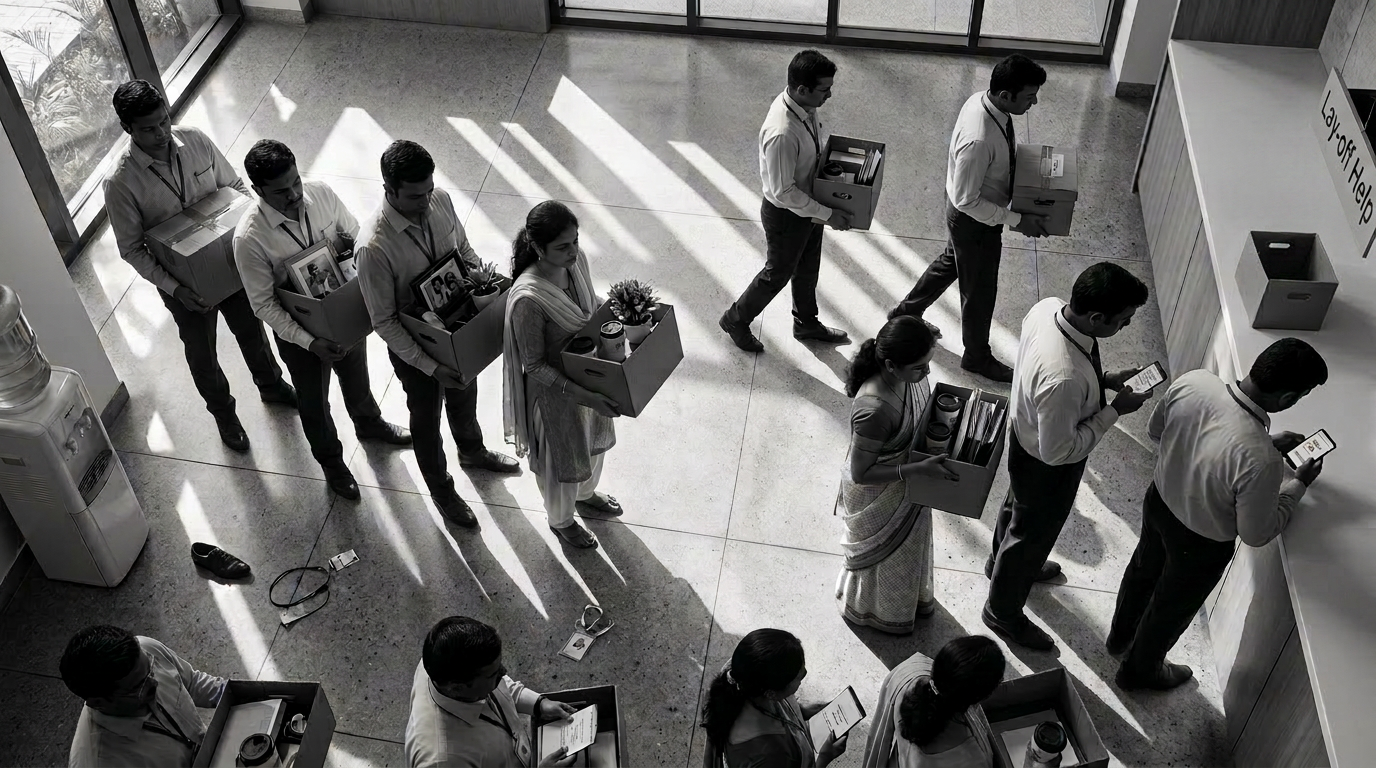
America is living through its biggest tech layoff wave in years, and every round of it is on the record. Employers planning mass job cuts must file advance notice with state authorities under the WARN Act, and those filings are public, searchable and read daily by journalists. When Amazon cut jobs in Washington state this spring, a filing said so. In America, a layoff can be unannounced. It cannot be unrecorded.
India is living through the same wave, sometimes at the hands of the same companies. Amazon's cuts are estimated to have reached 500 to 700 employees in India, and Intel, Microsoft and Salesforce have all trimmed their Bengaluru and Hyderabad centres this year. Yet the Indian public record contains nothing. No filings, because no law requires them. No statistics, because no agency collects them. No exchange disclosures, because the rules never ask. India's layoffs are invisible, not because companies hide them well, but because no part of the Indian system is built to see them. And a layoff the state cannot see is a layoff the state will never respond to.
How do other countries count their layoffs?
United States. The WARN Act requires employers with 100 or more staff to give 60 days' written notice of mass layoffs, filed with state authorities and published in searchable public databases. Coverage does not depend on rank; engineers, managers and directors all count.
Singapore. Any employer with at least ten staff must notify the Ministry of Manpower within five working days of retrenching even one employee, including professionals, managers and executives. The ministry publishes retrenchment figures every quarter, and each notification triggers re-employment support for the person affected.
United Kingdom. Employers proposing 20 or more redundancies must notify the government in advance. Failing to file is a criminal offence.
European Union. Collective redundancies must be notified to public authorities before they take effect, with mandatory consultation of worker representatives across all member states.
Japan, China, Australia, Canada. All oblige employers to report significant job cuts to the state, from Japan's public employment office filings to China's labour bureau reporting for cuts of 20 or more.
India. Notification exists only for the narrow 'worker' category, filed to labour departments and never published. For the office workforce, there is no filing, no notification and no count. Other countries ask how many people are being cut. India first asks whether the person cut counts as a worker at all.
How many jobs has India actually cut in 2026?
Nobody knows. That is not a rhetorical flourish; it is the finding.
The only sector where anyone attempts a count is IT, and even there the numbers are staffing-firm estimates: TeamLease reckons 10,000 to 15,000 technology professionals lost jobs by May, and projections reported by ETTech suggest 25,000 to 35,000 across the year. The hard numbers come from arithmetic, not disclosure. The combined headcount of India's five largest IT firms fell by 7,389 in the year to March 2026, with TCS alone down more than 23,000. Those are net changes in fact sheets, the shadow of the wave rather than a record of it.
And IT is India's best-documented sector only by accident. The visibility exists because the big firms are listed and their business model is manpower: investors track headcount as a revenue metric, so the number appears in quarterly fact sheets. It is disclosure for shareholders, not for workers. Beyond IT, in the GCCs, startups, banks and consumer companies where headcount is a cost line rather than the product, no numbers exist at all. The government has said as much: asked in the Rajya Sabha in 2022 about mass layoffs in IT, the labour ministry stated that no central data on layoffs in these sectors is maintained. Nothing since, including the Labour Codes in force from November 2025, has changed that.
What does a layoff look like in India?
It looks like a resignation. A silent layoff is a job cut executed through performance processes and negotiated resignations rather than announced retrenchment, and it is now the standard instrument of Indian white-collar workforce reduction.
The mechanics are familiar to anyone who has watched a team shrink: a performance improvement plan whose targets were never designed to be met, or a 'mutual separation' with severance conditional on an NDA and a resignation letter. The employee leaves as a resignation in the records, surfaces in the attrition percentage if anywhere, and tells the next interviewer they left to explore new opportunities. A company can restructure an entire business unit without a single event any law or statistician would classify as a layoff. The design is not accidental, as the law explains.
Are white-collar employees protected under Indian labour law?
Mostly, no, and the reason is a definition written in 1947. Retrenchment protection attaches not to being an employee but to being a 'workman', a category built for the factory floor and carried into the new Industrial Relations Code as 'worker'. Managers are excluded; supervisors above a modest wage threshold are excluded; employers routinely treat the entire modern office as outside the definition. The Karnataka High Court has held that a software engineer without supervisory duties does qualify, but the ambiguity cuts the employer's way: an employee must litigate their own status before protection even arguably applies, and almost none do.
For those who qualify, retrenchment carries real obligations: notice, compensation of 15 days' pay per year of service, notification to labour authorities, last-in-first-out rules. The strictest layer, prior government permission, applies only to factories, mines and plantations. India tracks retrenchments on the factory floor; the office floor is invisible. Hence the arithmetic behind the resignation letter: retrenchment triggers records and rules; a resignation triggers nothing, however it was obtained.
Don't listed companies have to tell the stock exchange?
No. Under SEBI's Regulation 30, the events deemed automatically material run from acquisitions to fraud to senior management resignations. Workforce reductions appear nowhere. Everything else is disclosed only above quantitative thresholds, 2 per cent of turnover or net worth, sized for capital events rather than human ones; no severance bill comes close. A company can part with 12,000 people and face no disclosure obligation, because the event is too cheap to matter.
The schedule does name one workforce event: disruption due to strike or lockout. The system notices when workers withdraw their labour from the company, not when the company withdraws jobs from the workers. The single exception proves the point: India's largest listed firms must confirm or deny media reports that move their share price, meaning a company can be compelled to speak about layoffs only after a journalist finds out first.
What does no reporting cost?
Everywhere else, the report is the trigger for help. Singapore's five-day notification is not filed into a void; it activates re-employment support for the specific person retrenched. America's WARN notice buys the worker 60 days and routes state rapid-response teams to the affected site. Britain's advance form exists so the state can prepare before the redundancies land. The sequence is the same in every system: the company must tell someone, and because someone is told, something happens.
India has no first step, so the sequence never begins. No report means no early-warning signal for policy, no severance benchmarks, no evidence base when the labour codes are next debated, and, at the level of one person's life, no state that even knows they need anything. The professional pushed into a mutual separation falls out of every system at once: off the payroll, outside the worker definition, invisible to the labour department, absent from any statistic. The laid-off American at least knows tens of thousands received the same message. The Indian professional signs the NDA, owns the resignation letter, and is left to believe they alone failed.
One irony is heading this way. Former Amazon employees told CNBC that as the company cuts in America, it is hiring in India, at a fraction of Seattle cost. The jobs leaving the world's most documented layoff regime are arriving where their eventual elimination will leave no trace, and no help will follow, because no one will have been told.
We tried to count. Under the present system, nobody can. Wocult intends to keep trying.
Sources
- CNBC, 'Burnout, frustration and heartbreak: Amazon layoffs take their toll in saturated job market', 11 July 2026
- ETTech reporting of TeamLease and CIEL HR Services estimates on India IT job cuts, 2026
- Company quarterly fact sheets and annual filings, TCS, Infosys, HCLTech, Wipro, Tech Mahindra, FY26 (to be re-verified before publication)
- Rajya Sabha, reply of the Minister of Labour and Employment on layoffs in IT and related sectors, December 2022
- Industrial Relations Code, 2020, and Industrial Disputes Act, 1947
- Karnataka High Court jurisprudence on software engineers as workmen (citation to be confirmed in legal review)
- US Department of Labor, WARN Act; state WARN databases
- Ministry of Manpower, Singapore, mandatory retrenchment notifications and Labour Market Report
- UK Insolvency Service, form HR1; EU Collective Redundancies Directive
- SEBI (Listing Obligations and Disclosure Requirements) Regulations, 2015, Regulation 30 and Schedule III

.jpg)


%20(1).png)

.png)