

What is actually happening
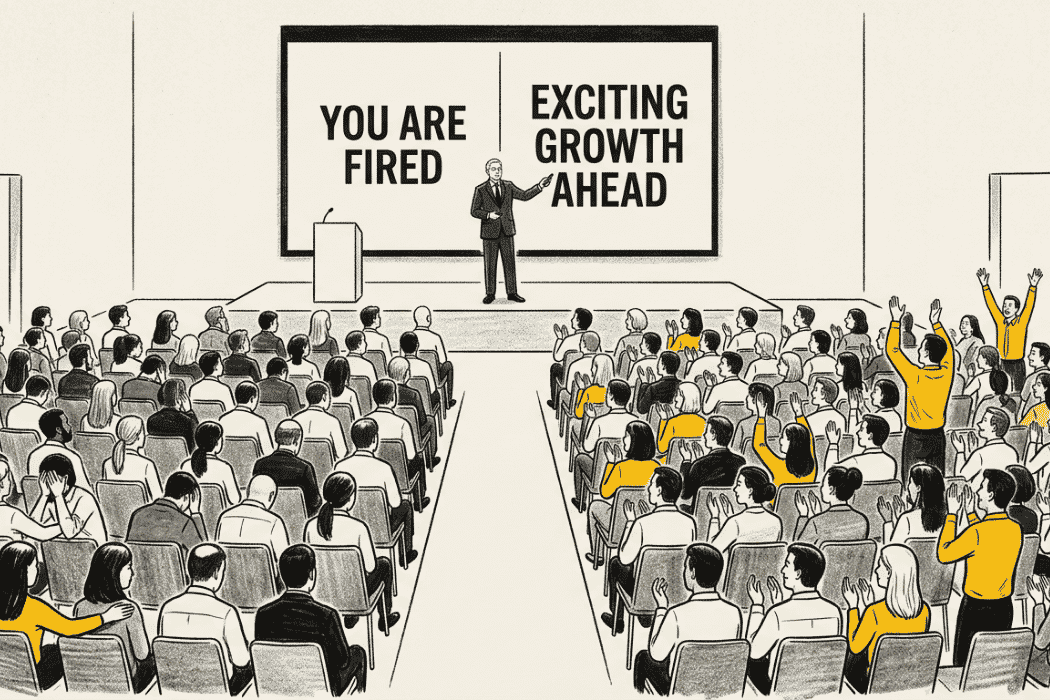
Across India and globally, three disruptions are happening simultaneously : the mass layoffs, AI-driven rehiring, and structural restructuring. Most organisations are treating them as three separate operational events but actually they constitute one profound cultural event. And most organisations are navigating it without realising what is actually at stake.
Mass layoffs often remove the people who carried institutional memory, informal culture, and the relational trust that holds teams together, not just the low performers. These are frequently the people who knew how the organisation actually functioned as a human system, how decisions really got made, how conflicts got resolved, how trust got built.
AI-driven rehiring is bringing in people selected for skills that did not exist in the previous culture. They arrive without context, without history, into a workplace already in flux. The onboarding tells them what the organisation values. Nobody can show them what the organisation has been because many of those people are gone.
Restructuring : flatter hierarchies, matrix teams, new reporting lines, is changing the architecture through which culture is transmitted. The informal networks, the mentoring relationships, the cross-team trust built over years, all being rerouted through structures that have not yet earned the credibility to carry them.
The result is not always a destroyed culture, it is often an accidental one. A culture built from the residue of what survived the cuts, the habits the new hires brought with them, and the behaviours the new structure inadvertently incentivised.
The Bolt signal
When Bolt's CEO fired his entire HR team and called them "a source of problems that did not exist", he did something many leaders in restructuring mode can quietly consider. But here is the reframe that most are missing: HR is the custodian of culture. And replacing or rebuilding the HR function with intention is one of the most consequential cultural design decisions an organisation can make. Done right, it is a generational opportunity to move the organisation from good to great. Done carelessly, it simply accelerates the drift toward an accidental culture.
What did Jim Collins, author of the book Good to Great, say ?
Collins identified the flywheel : great cultures are not built in a single dramatic moment but through consistent, disciplined, cumulative effort that reaches a tipping point. Push after push after push, in the same direction, until the momentum becomes self-sustaining. The opposite is the doom loop, organisations lurching from one initiative to another, never building enough momentum for culture to take root. Mass layoffs followed by AI-driven rehiring followed by restructuring, without intentional cultural architecture, is a doom loop. It feels like progress because things are moving but the direction keeps changing, the people keep changing, and the culture never compounds.
Collins suggested in the book that greatness is largely a matter of conscious choice. It's not an easy choice but chosen in the moments of highest pressure, by leaders willing to take the harder path.
The opportunity
Turbulence is not the enemy of culture. It can be its crucible — a hidden opportunity that most organisations walk past without recognising. Every great culture in Collins' research was forged during difficulty when the easy options were available and leaders chose the harder and a more disciplined path. The organisations that came out stronger did so because of how they consciously chose to navigate the turbulence, not despite it.
The layoffs, the AI rehiring, the restructuring — none of this has to produce an accidental culture. It can produce a deliberately better one. But only if someone in the room is asking: what do we actually believe? Who embodies that? What behaviours will we reward, regardless of the pressure not to?
That is not an HR conversation, it is a leadership conversation. And it is the most important conversation most organisations are not having right now.
Every organisation restructuring right now is making a cultural choice whether they realise it or not. The ones that do, are the ones that will look back in a decade and understand why they became great while everyone else stayed good or deteriorated to something worse.
.jpg)
%20(1).png)

.png)