





Q1. You once asked a CEO who kept telling his people to “embrace uncertainty” — when did he last feel uncertain himself. He went quiet. What did that moment tell you?
What he didn’t say was the answer.
He had been telling his people, for months, to embrace uncertainty. When I asked him when he had last felt it himself, he reached for an answer and couldn’t find a recent one. The silence wasn’t dramatic. It was the quiet recognition that we had both stepped into something true.
He wasn’t being dishonest. He believed in what he was asking of his people. But he had built a career on certainty, on having answers, holding direction, being the steady one. Uncertainty had become something he asked others to absorb on his behalf.
That moment told me what I have come to recognise as a recurring pattern, not a universal one, in many of the senior rooms I sit in across sectors and countries. The further people rise, the more they begin to ask of others what they have quietly stopped asking of themselves. It is a slow forgetting. Senior leaders are paid to hold steady. Over time, holding steady becomes the only stance they remember how to take.
They keep asking for vulnerability while protecting their own with care. The conversations about adaptability happen from the same chair they have sat in for years. The word uncertainty itself becomes a topic they teach, no longer a state they recognise inside themselves.
What is felt in those rooms, and almost never said, is that everyone already knows. The team knows. The leader knows. They have made a quiet agreement that no one will name it.
The CEO didn’t break that agreement out loud. He simply, for a moment, allowed the truth into the room without putting words around it. That is more than most leaders ever do. The reason isn’t lack of will. It is that, in too many places, no one in the leader’s world has the standing to ask them the question, and their people have learned to stop expecting an honest answer in return.
Q2. You’ve been coaching leaders for a long time. Why do senior leaders need coaching at all — aren’t they supposed to have figured it out by now?
The popular assumption is that senior leaders have figured it out. The accurate observation is that the seat itself does not reward the kind of examination that would help them keep figuring it out.
Senior roles are structurally lonely in a particular way. Direct reports edit themselves before they speak. Peers are usually competitors, watching what works in someone else’s seat. Boards stay focused on outputs. The friction that used to push a person to grow has quietly gone missing from their day. What replaces it is success, and success is one of the most distorting forces in a leader’s career. Patterns that worked once harden into defaults. Strengths keep being applied where they are no longer the right tool. From the inside, none of this looks like a problem. It looks like experience.
There is something else, harder to put into words. At this level of seniority, you cannot show that you don’t know. You cannot show that you are afraid, tired, unsure, or that the answer hasn’t arrived yet. The pretense isn’t optional, it is part of the role. There is shame inside it too — the quiet, persistent worry that being seen unsure at this level will be read as unfit for the seat. That shame is largely manufactured by the system the leader is operating inside, but it is no less real for being manufactured. After enough years of it, something quieter happens. The leader doesn’t only stop showing what they feel. They begin to lose contact with what they feel. The performance becomes more available than the person.
This is what enshrinement does. Organisations elevate senior leaders to a place of such distance that ordinary humanity becomes hard to access, for them and for the people around them. Their questions are read as direction. A silence is read as judgement. Tiredness becomes displeasure to anyone watching. The leader stops being treated as a person in process and starts being treated as a position. Once that happens, the position is the only thing the room can see.
By then, most leaders have not been asked a hard, neutral question by anyone in years. Their teams have stopped trying. Their peers have moved on to their own concerns. Their families have learned which conversations are worth having and which ones aren’t. The leader continues to operate skilfully, and continues to lose contact with parts of their own thinking that nobody is testing.
The most useful reframe I have come to is this. Senior leaders are humans in process, like the rest of us. Seniority is not a graduation from being human. The role demands that they hide it. The hiding is the cost, not the truth.
Coaching, done well, is one of the few rooms in a senior leader’s life where someone has both the standing and the obligation to ask. Whether they use that room depends entirely on them. The leaders who use it well are not rare individuals. They are usually leaders who arrive without their title in their hand, willing to be wrong out loud. Some of the most quietly significant leadership work I have witnessed has happened in those rooms — not because the people in them were exceptional, but because they were willing to use one of the few spaces in their lives where being uncertain was permitted. Other leaders walk in expecting consultation, advice, or affirmation, and walk out with a coach who has either stopped pretending or stopped working with them.
What also tends to surprise leaders who use coaching well is what it actually does. The coaching that helps them is rarely the kind that gives them more — more strategy, more frameworks, more feedback, more tools. It is the kind that returns them to themselves. Restoration before improvement. That distinction is not soft. It is the difference between leaders who keep evolving and leaders who keep accelerating without direction.
What I have come to believe, after building coaching architecture for 6,50,000 people across 49 countries, is that the most senior leaders are usually the most underserved by coaching at the start, and the ones whose growth shifts the organisation the most. The reason is simple. The further up someone sits, the more their unexamined patterns become the working conditions for everyone below them. The unexamined senior leader is the most expensive person in the building. The leader being restored to themselves is also being restored to the part of them that was once curious about their own work. That part is what fulfilment is built on. It is the precondition for everything else they were originally hired to deliver.
Q3. Middle managers are hired to hit deadlines, not fix culture. So why should they care about their team’s fulfilment?
Most middle managers I work with already know their teams are running on empty. They also know they aren’t supposed to say so.
That is the place from which to answer this question. The framing inside the question, that managers are hired to hit deadlines and not to fix culture, is the framing the system has trained them in. It is convenient. It is also why so many quarters get delivered and so few teams survive them.
Middle managers don’t get promoted for being good at people. They get promoted for being good at the work, then handed a team and told to deliver. The actual work of leading other human beings, most of them figure out on their own, while still doing the job they were originally hired to do. They are usually as depleted as the people they are managing, pressed from above to hit numbers already set, and from below by a team that needs more from them than they have left to give. They sense their team is fraying. The deck still says high performing. The shame they carry, quietly, is the gap between what they see in their people every day and what they are required to perform in the room above them.
In India this squeeze lands particularly hard. Many middle managers are also navigating multi-generational household economics, joint-family obligations, and the pressure of being the visible success in their extended family. The pretense at work is matched by the pretense at home. The cost is felt in places no quarterly review can see.
What I would say to them, after years of watching this play out, is something most of them already half-know. You do not have to fix culture. You are the culture, for the people reporting to you. Culture in their working lives is not what HR sends in a deck. It is you. It shows up in how the Monday meeting actually runs and in what gets protected when a senior leader rolls a deadline. It shows up in whether disagreement gets aired or absorbed, and in where the credit ends up landing. The team experiences these moves long before they read any culture statement.
There is a polarity worth holding here. Some pace in the work is real and earned. Some pace is theatre. Distinguishing between the two is one of the harder, more important things a manager can learn to do — for themselves and for their people. A manager who treats every deadline as sacred runs their team into the ground for some that didn’t need to be sacred at all.
So the answer to “why should they care about fulfilment” isn’t a moral one. It is operational. The output of any team is not a function of how hard people work. It is a function of how present, energised and committed they are while working. A team that has been worn down delivers worn-down work. The manager then runs the same hard quarter twice. Once because the result was poor, then again because the people who delivered it have left and the next quarter has to be built without them. When a team’s fulfilment goes up, retention, judgement and adaptability go up with it. Those are the metrics that quietly determine whether a quarter holds together or falls apart.
The organisation is asking too much of these managers. The team is asking too much of them. Both are true. The honest question isn’t whether they should care. It is what to do with the agency they actually have, and where the system above them needs to stop pretending the squeeze is sustainable.
Q4. In a market as competitive as India, people believe if they don’t burn themselves into the ground, someone else will. What can companies actually do to change that?
The fear inside the question is real, and it isn’t paranoia. India has 1.4 billion people, and the queue for any well-paying role is real. To pretend otherwise would be to insult the reality the reader is sitting inside. The honest argument isn’t that the fear is imagined. It is that the system has organised itself around exploiting the fear instead of designing around it. That fear is felt every day, and it is the engine of a system most leaders quietly know isn’t working.
What gets ignored is that the system isn’t a cultural inevitability. It is the cumulative effect of thousands of small decisions we have already made about who gets praised, promoted and protected. The person who replies to emails at midnight gets noticed. The person who delivers cleanly and logs off rarely does. Multiply that across thousands of managers and you have the workplace we have.
There is a polarity worth holding here too. Some intensity in the work is real and earned — surgeons, deal-closers, people inside critical operational windows. The intensity that empties people, decade after decade, without any structural recovery, is something else. Most organisations have stopped distinguishing between the two, and have outsourced the cost of that confusion to the bodies and families of the people doing the work.
Companies don’t change this through wellbeing campaigns. They change it by changing what the organisation actually rewards, visibly, repeatedly, and at the top. Senior leaders step away when they are depleted, instead of pretending they aren’t. Promotion criteria stop being about output alone and start including the health of the team that produced it. Managers whose teams burn out face real consequences, not workshops for the people they burned out. Calendars build in recovery, instead of “wellness weeks” stitched onto schedules that have not changed.
None of this is exotic. All of it is uncomfortable, because it requires the people setting the example to change first. The reason most companies don’t is not that they don’t know how. It is that they are unwilling to disrupt the very behaviours that built the place. The behaviours that built the place are also the behaviours wearing it out, and that is the part most leadership teams refuse to name in their own meetings.
The companies that have started to shift this aren’t the most enlightened ones. They are the ones that have realised they cannot keep replacing the same people every two years and call that growth. I have seen this in family-led businesses that quietly value their people and resist the consultancy script, in technology companies that have started measuring depletion as well as delivery, and in a small but growing number of professional services firms that are willing to walk away from clients who burn their teams out. They are not the loudest companies. They tend to be the ones that, ten years from now, will still be in business with the people who built them.
Q5. Mindfulness sessions, mental health days, employee helplines etc, is any of it actually working, or have they become the new way to avoid the real conversation?
These tools are useful. They are also, in many of the organisations I have worked with, a way for the company to feel it has done something without doing the harder thing.
Mindfulness sessions, mental health days, helplines, app subscriptions, none of these are bad. Used well, they help. Used as substitutes for examining the conditions of work, they become a kind of theatre. The employees in the room usually know which one it is, even if no one says so.
A meditation app does not fix a manager who runs meetings on intimidation. A helpline cannot recover someone whose role has been quietly impossible for two years. A wellness week will not undo eleven months of unsustainable design. These tools address the symptoms of overload while leaving the conditions that produce overload entirely intact.
Many of the HR leaders I know are fighting hard inside their organisations for something better, with the budget, mandate and political room they have been given. They aren’t the problem. The problem is what gets approved and what doesn’t — and what the senior leadership team treats as evidence of care. In too many of these rooms, demonstrating care is itself rewarded as care, and the programme keeps running because the participation numbers look healthy and the stories make for good slides.
The shift that actually changes outcomes is harder and slower. It is examining the design of the work itself. Why does this team need to operate at this pace? Who set the expectations, and on what evidence? What is the organisation unwilling to give up, whether that is clients, growth rate, or headcount targets, in order for this not to be necessary? These are the questions wellness programmes were never built to ask.
When companies are willing to ask them, support tools become useful. They move from cover to scaffolding. Until then, they keep being expensive demonstrations that the organisation knows the right language without yet being willing to do the work.
Q6. What does actually caring for people look like at work, not in a company policy, but on an ordinary Monday? Can you give us a few examples of cultures that genuinely enable fulfilment?
It looks ordinary. It is repeated. And it is deliberate, in a way that often goes unnoticed because nobody puts a banner over it.
The cultures I have walked into where people are fulfilled feel different before anyone explains why. People speak more freely. They edit themselves less. They sit in meetings without protecting themselves. The change is felt before it is named, and that is part of the point. Care that has to be announced has usually already lost most of its meaning.
What is interesting about these cultures is that they are felt in the absence of things, not the presence of them. There is an absence of dread. An absence of editing. An absence of guarding. Most measurement instruments are designed to detect what is present in a workplace. The thing that signals fulfilment is what is no longer there.
What it actually looks like, on a Monday at 11.30am, is often very small. A manager who notices someone has gone quiet for two weeks and asks privately, with no agenda. A leader saying “I don’t know” in a meeting where it would be easier to perform certainty. The salary review that doesn’t depend on how loud someone has been. A senior leader who pulls back the deadline themselves before the team has to ask. A Friday message that says, simply, take Monday.
These sound small because they are small. That is also why most organisations don’t notice when they aren’t happening. Cultures are not built on grand gestures or off-sites or town halls. They are built on what the people in charge do on an ordinary morning, when there is no campaign attached and no one is watching.
The cultures I have seen that hold fulfilment over time have three things in common. People know what they are being held to, and the standards don’t shift on a manager’s mood. Disagreement is allowed and doesn’t get punished later. A hard week is not treated as a problem in the person. None of these are programmes. They are decisions, made by the same people, every day, in moments small enough to miss.
What these cultures get right, structurally, is that they have stopped treating fulfilment as something that arrives after performance. They have started treating it as the precondition for performance. The work the rest of the market cannot replicate is what comes from a place where people aren’t quietly fighting to remain themselves.
That kind of culture isn’t loud. It rarely wins awards. It does, however, keep its people for a long time, and tends to keep producing the work the rest of the market cannot replicate.
Q7. Can you give us an example of a well-intentioned culture initiative you’ve seen that actually made fulfilment harder to achieve. What went wrong?
A recognition programme designed to surface the quiet contributors. It ended up doing the opposite.
What is worth honouring before any critique lands is that they tried. Many organisations notice this gap and do nothing. The team that designed the programme did the harder thing — they decided the existing system was failing some of their best people, and they committed budget and political capital to addressing it. The architecture failed. The intention shouldn’t be confused with the failure.
The organisation had noticed that the same names kept showing up for promotion, while a layer of consistent, capable, lower-volume people stayed invisible. They built a programme to surface that second group: peer nominations, public stories of impact, shared visibility.
What happened was predictable in retrospect. The criteria were left vague, so people defaulted to nominating who they liked. The nominations were public, so social dynamics decided most of them. Within two cycles, the programme had become a louder version of the same problem. The people who already had voice received more of it, and the people the programme was designed to surface watched it happen.
What was felt and not said inside that company, by the second year, was that the programme had quietly become a confirmation of the existing hierarchy. The HR team running it knew the data was uneven. The employees attending the recognition events knew which names would be called. The senior leadership team kept approving the budget, because the participation numbers looked healthy and the stories made for good slides. The programme had become something the organisation could point to as evidence of care, while the experience of invisibility for the people inside it had only deepened.
I have seen versions of this in India, in the United States, and across Europe. The cultural texture varies. The architectural failure is the same. Human beings under social pressure tend to default to who they already see and who they already like, regardless of geography. Designing around that pattern is what culture work actually requires.
This is what well-intentioned culture work fails on. The intent is rarely the issue. The architecture usually is. The design did not anticipate how people behave under social pressure; it was built on an idealised version of fairness that real human beings, in real organisations, rarely produce.
The lesson I have come back to, after seeing different versions of this across sectors, is that culture initiatives have to be tested the way you would test a piece of infrastructure. Where does it strain. What does it reward that no one set out to reward. Who does it harm, in practice, that it set out to help. Without that kind of scrutiny, good intentions become evidence the organisation has done the work, when the work has barely begun.
Q8. A lot of people would trade a meaningful life for a bigger paycheck if they had to choose. Is fulfilment at work even a realistic conversation for most people?
The framing of the question is the problem. Most people aren’t being asked to choose between meaning and a paycheck. They are being handed a structure and told this is what is available, and they are quietly absorbing the cost of that structure inside their own lives.
The trade-off is real for some people. At survival-level pay, the conversation about meaning is the wrong one to lead with. There are also constraints that don’t look like survival but operate like it — a sole earner, a visa-tied role, a parent or sibling who depends on a particular salary, a household of school fees and ageing parents and medical care no one else is covering. Those constraints are real, and they make the trade-off feel binary in ways that are not theatre. Acknowledging that has to come before any reframe.
For most professionals reading this who are not inside those constraints, the choice between meaning and money is not a binary they were given by reality. It is a binary they have inherited from the system around them, and the cost of that inheritance is one they often cannot name until much later in their lives.
What is harder to see, until they are sitting on the other side of it, is that the trade was never really about money. It looked like money. It was about identity. The trade was: who do I want to be at work, and how much of that am I willing to give up to keep being employable here. Looking at the trade in those terms makes a different conversation possible.
What I notice, across most of the senior leaders I have coached over the years, is that nobody arrives at fifty saying they made the wrong trade in those words. They arrive saying that the salary is what they wanted, and the life around it is no longer one they recognise. They sometimes say, quietly, that they cannot remember the last time they felt curious about their own work. That is the felt cost of a trade-off that looked rational at every individual decision point, and produced a result they did not consciously choose.
I came to this view late. There were stretches of my own career where I traded for the salary and the title because they felt safer, and where the cost was paid by parts of me I am still rebuilding. That cost is what I now spend much of my work helping other people see earlier than I did.
Fulfillment is not a luxury that arrives once the basics are paid for. It is the foundation that keeps the rest of life standing. It is the condition that allows someone to keep being effective in their work over decades, instead of grinding themselves into a version of themselves they no longer want to be. That isn’t aspirational language. It is what determines whether someone is still capable of doing the work in their fifties, and whether the people around them recognise the person who used to be there.
Both things are true. Money is real and the lives it allows are real. Meaning is real and the life it sustains is real. The trap is treating them as exchangeable, as if more of one automatically buys you less of the other. The honest version of this conversation is not “would you take less money for more meaning.” It is “what would you change if you understood that meaning is what makes the money sustainable, and the absence of it is what makes a successful career feel hollow at fifty.” That is a harder question, and a more useful one.
For most working professionals, fulfilment is not the luxury layer on top of life. It is what allows the rest of life to keep working. That conversation is realistic. It is also overdue.
Q9. Gen Z gets called lazy and entitled. But they also set boundaries, say no, and walk away from bad jobs without guilt. Are they actually onto something the rest of us aren’t?
Yes. The packaging is uneven. The principle is right.
The label “lazy and entitled” is itself a defence. It is what people often reach for when something they have absorbed all their lives is being refused in front of them. Gen Z is refusing it. They draw lines earlier. They name behaviour older generations coded as normal. They walk away from work that erodes them, and they do not perform regret about it. That last part is what tends to land hardest.
Some of the delivery is clumsy. Some of it would be easier to hear if it came with more patience for what older generations were navigating, and more recognition that not every demanding manager is a danger. That is a fair critique of the form.
It is not a critique of the substance. The substance is sound. The work patterns previous generations absorbed were costing us things we didn’t admit to ourselves until much later. Loyalty, framed as virtue, often masked a fear of leaving. The exhaustion we wore as a badge produced a generation of professionals who arrived at fifty without recognising themselves outside their job titles.
Part of what older generations were navigating wasn’t just hard work. It was the unwritten rule that any sign of refusal would mark you. The label would arrive — “difficult,” “not a fit,” “high-maintenance,” “too intense,” “not collaborative,” “dramatic.” Once attached, it followed you into the next role, the next conversation, the next reference call. So most of us learned to censor ourselves long before we had consciously decided to. The system did not have to silence us. We did the work for it. Organisations are very good at quietly cancelling people who are too real, and most of us learned to read the signal early.
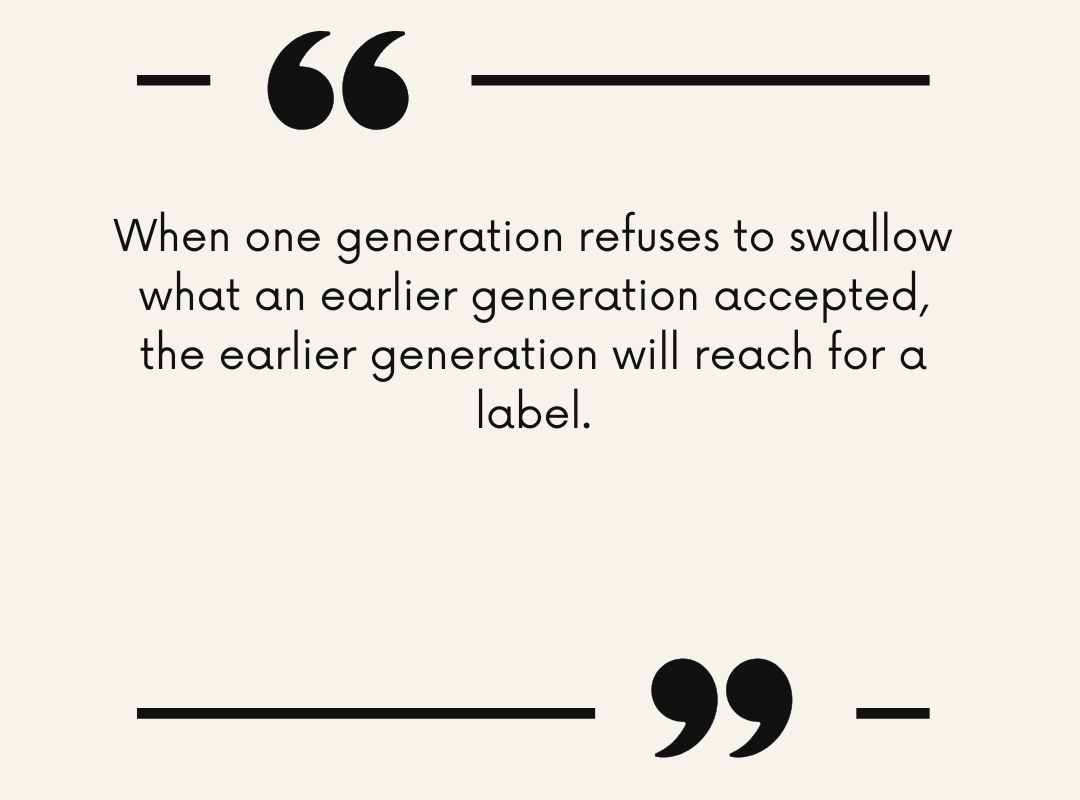
Gen Z in India is not the same as Gen Z in California. The economic stakes are different. The family structures are different. The visibility costs are different. What is the same, across geographies, is the human pattern: when one generation refuses to swallow what an earlier generation accepted, the earlier generation will reach for a label.
What is felt, quietly, by a lot of mid-career people I work with is that Gen Z is articulating something they envy. They have watched young people leave roles their own generation would have stayed in, and they are not sure whether to be irritated or relieved. The dismissal is loud. The recognition is private. Both are happening in the same room.
The right response is not to dismiss. It is to take the principle seriously, help young professionals sharpen the language where it is still rough, and let them help the rest of us name what we never had words for. There is something for both sides to learn in that exchange. Most workplaces are choosing not to.
Q10. What’s one thing leaders should stop doing immediately if they actually want to build cultures where fulfilment can be developed?
Stop asking people to bring their whole selves to work, until you have built a place that can hold a whole self.
There is a deeper problem with the language too. Most people do not actually want to bring their whole selves to work. They want to bring a boundaried, professional self that is treated with dignity, allowed to disagree, and not punished for being human. “Whole self” is the wrong frame even at its most well-intentioned. What people actually need is a place where the self they choose to bring isn’t the cost of admission.
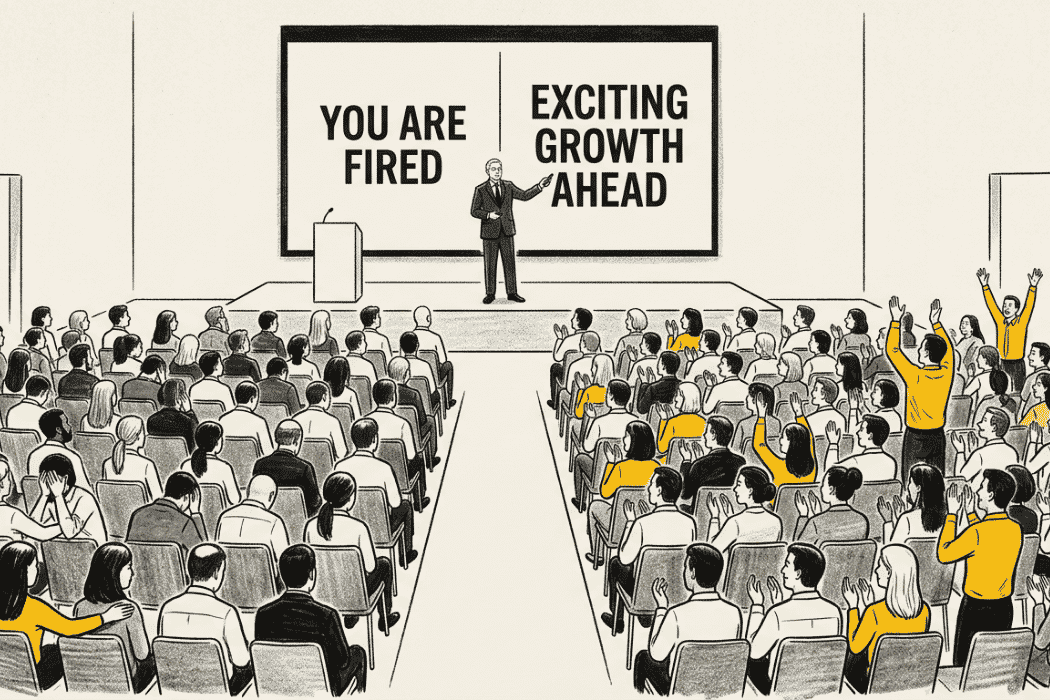
The phrase has become almost meaningless inside most organisations. Almost every company says it. Almost none has done the work to make it true. People bring small, edited portions of themselves to work because the larger version is not safe in the room. Disagreement gets coded as difficulty. Distress gets coded as instability. Ambition gets coded as politics. People learn this quickly and adjust. They stop bringing the parts that cost them.
What has happened in many organisations is more specific than people pretending. People learn early which parts of themselves get them marked. The labels that follow — “difficult,” “not a fit,” “too intense,” “high-maintenance,” “dramatic” — are doing real work in those buildings. Once attached, they follow. So people do the work of censoring themselves long before any leader has to ask them to. The system does not have to silence anyone. It teaches us to do it ourselves. That is the deeper architecture leaders are usually not looking at.
What gets felt, and never said, is that employees know the gap between the language and the reality long before any leader does. They have already calibrated what they can show. The leader using the phrase is often the last person in the building who still believes it is operating.
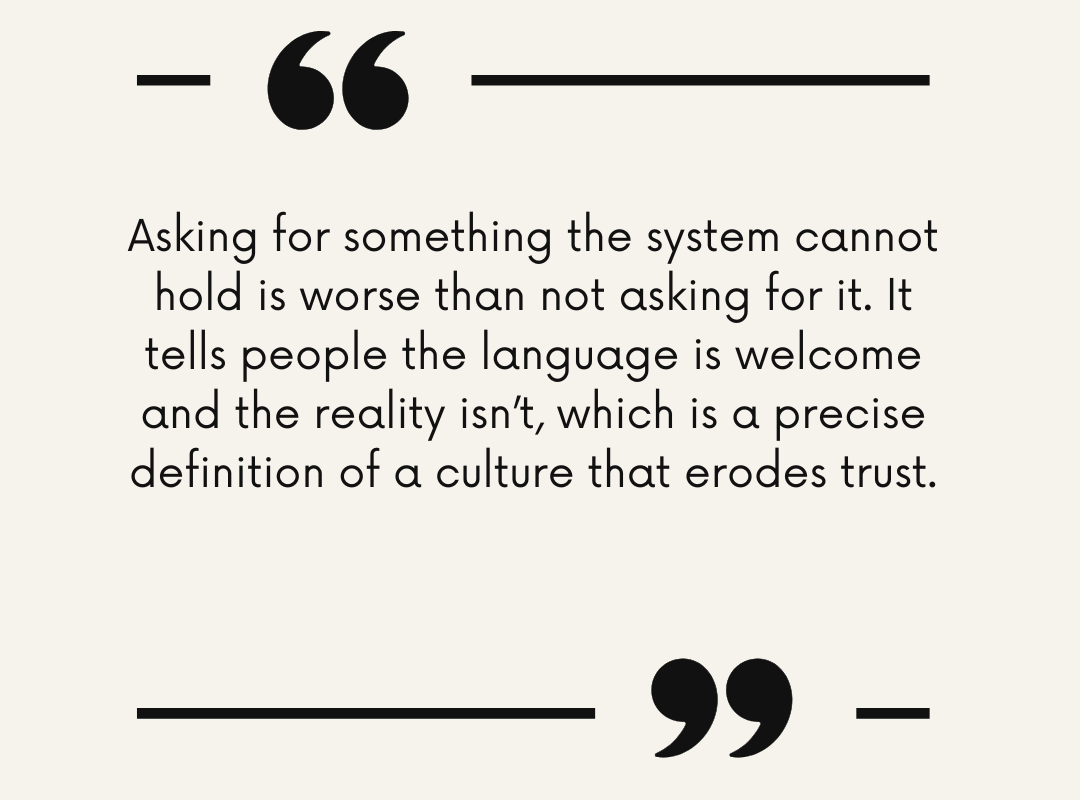
Asking for something the system cannot hold is worse than not asking for it. It tells people the language is welcome and the reality isn’t, which is a precise definition of a culture that erodes trust.
What I have come to see is that there are really only two coherent positions to hold here. Either redesign the place so a self-with-edges can show up safely, or stop using the language. Holding both together is what corrodes trust over time.
The redesign is real work, not a slogan. It shows up in how disagreement is handled, in how someone is held through a hard month, in how performance reviews actually run, in how the most senior people behave when they are challenged in a room full of juniors. None of this is invisible. It takes time, and it asks the people setting the tone to change first.
The leaders I have most respected on this question are the ones who have used the phrase for years and are now sitting honestly with the gap. They are not pretending it has worked. They are quietly asking what they would need to do differently for the language to start meaning something. That work is real, and it deserves grace. Where a leader is not yet willing to do that work, the more honest position is to retire the language. Continuing to ask for what the building cannot hold is what hardens cynicism in the people who hear it.
Q11. At what point is leaving a job just the healthiest thing a person can do?
When the cost of staying has become invisible to everyone except your body.
Leaving is often framed as failure. It is sometimes the most accurate decision a person can make about their own life.
The signs are usually clear before we admit them. A persistent, low-grade dread on Sunday evening. A version of yourself at work that you no longer recognise. Things you used to be proud of starting to feel performative. Conversations at home that keep circling the same exhaustion. A sense that you are protecting the role at the expense of yourself. The body, which has been quieter than the mind for a while, eventually stops being polite about it.
None of these are conclusive on their own. Together, over time, they are. They are also the signals that organisations are very good at training people to override, and that mid-career professionals are very good at training themselves not to hear.
What is felt and not said in this part of someone’s life is often clearer to the people around them than to the person living it. Spouses notice. Old friends notice. The body has already noticed. The professional voice in someone’s head argues for staying, because the salary is good, the title is hard-won, and the next role isn’t yet visible. That voice is honest about the cost it can name. It is silent about the cost it can no longer feel.
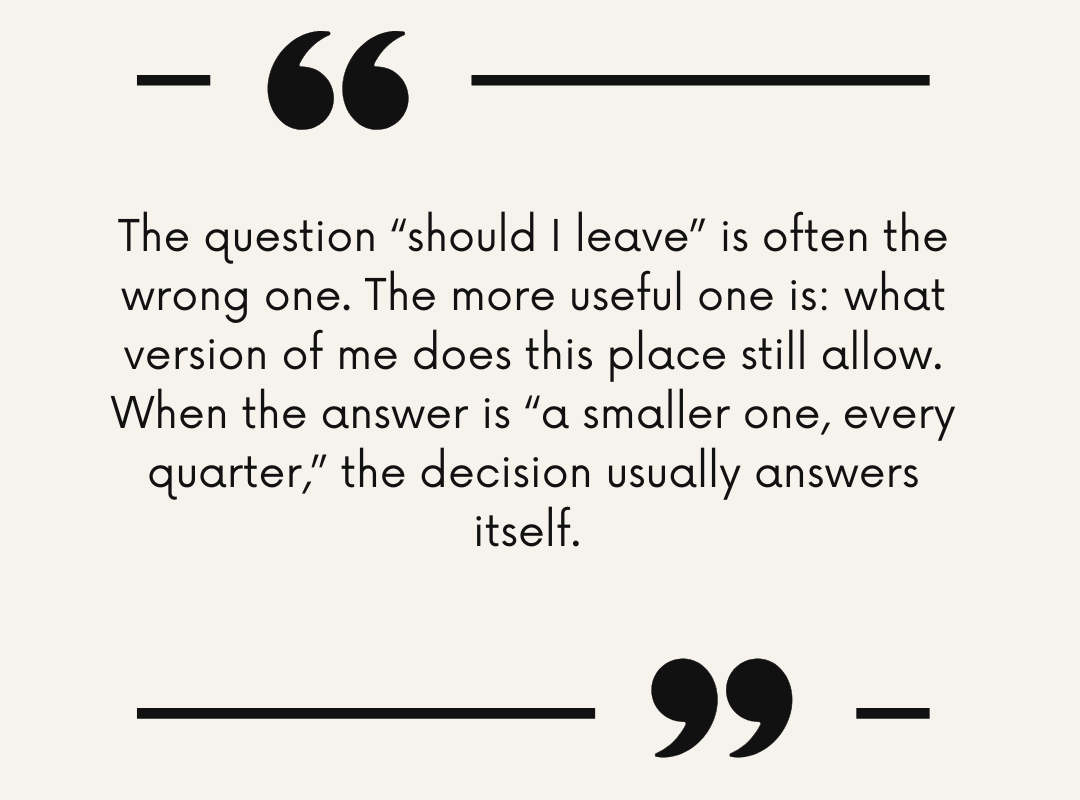
The question “should I leave” is often the wrong one. The more useful one is: what version of me does this place still allow. When the answer is “a smaller one, every quarter,” the decision usually answers itself. When the answer is “most of me, with some friction I can name,” staying is often the more honest choice.
Leaving is the right answer when staying requires you to keep paying a cost you would not advise someone you love to pay. That standard is simple, and it is mostly accurate. Many of the senior leaders I work with would have left a role earlier had they used it. I include myself in that. There were stretches I should have left earlier than I did, and the cost of staying past my own answer is one I have walked through and would not advise again.
Leaving is also a privilege not everyone holds equally. Sole earners. Visa-tied workers. People supporting parents or siblings or schools. People with health considerations they don’t disclose at work. The standard above still applies, but the cost of acting on it is not the same for everyone. For people without mobility, the more useful question is what conditions inside the role can be reshaped, and what to do when the answer to that is no movement at all. Sometimes the work is to leave. Sometimes the work is to stay differently, and to build the mobility that will make leaving possible later.
The healthier conversation is not whether to stay or go. It is what conditions you would need for staying to be sustainable, what is in your control to ask for, and what you will do if the answer is no. Once you have sat with that, the decision usually becomes obvious.
About Preeti D’mello
Preeti has spent 35 years in the rooms where leadership either works or quietly fails. As Co-founder and President of The Fulfillment Institute, she works with senior leaders across 46 countries — not to give them more frameworks, but to return them to the parts of themselves that the role has trained them to set aside.
Before founding TFI, she spent a decade at TCS as Global Head of Coaching, Leadership Development, and Diversity and Culture. Over the course of her career she has worked with over 12,000 senior leaders and certified more than 750 coaches. She holds an ICF PCC credential and has served as Chair of the ICF Global Board for Coaching in Organizations.
Her work is built on a single observation: the most expensive person in any organisation is the one whose patterns have gone unexamined. What she does, in the room and over time, is create the conditions for that examination. The rest tends to follow.
.jpg)


%20(1).png)

.png)