



.png)
We asked Jessica Kelly, a communication and leadership consultant, mindset coach and the founder of The Mindset Consultancy, who has spent seven years coaching leaders across industries and continents about what separates a genuinely bad manager from a merely demanding one, and why the damage so often stays invisible to the people with the power to stop it.
1. Wocult's research ranks bad managers as the number one pressure on corporate employees, above burnout, job insecurity, and toxic culture. In seven years of working with leaders across organisations, in your opinion, what does bad management mean?
Every business has one core objective, which is to generate revenue while serving its customers and clients well. Alongside that objective sits a responsibility that is just as fundamental: creating a psychologically safe environment for the people who work there. In my seven years of working with leaders across organisations, what I consistently see is that bad management is what happens when that responsibility gets replaced by ego, and a culture built to serve everyone quietly becomes one that serves whoever holds the most power.
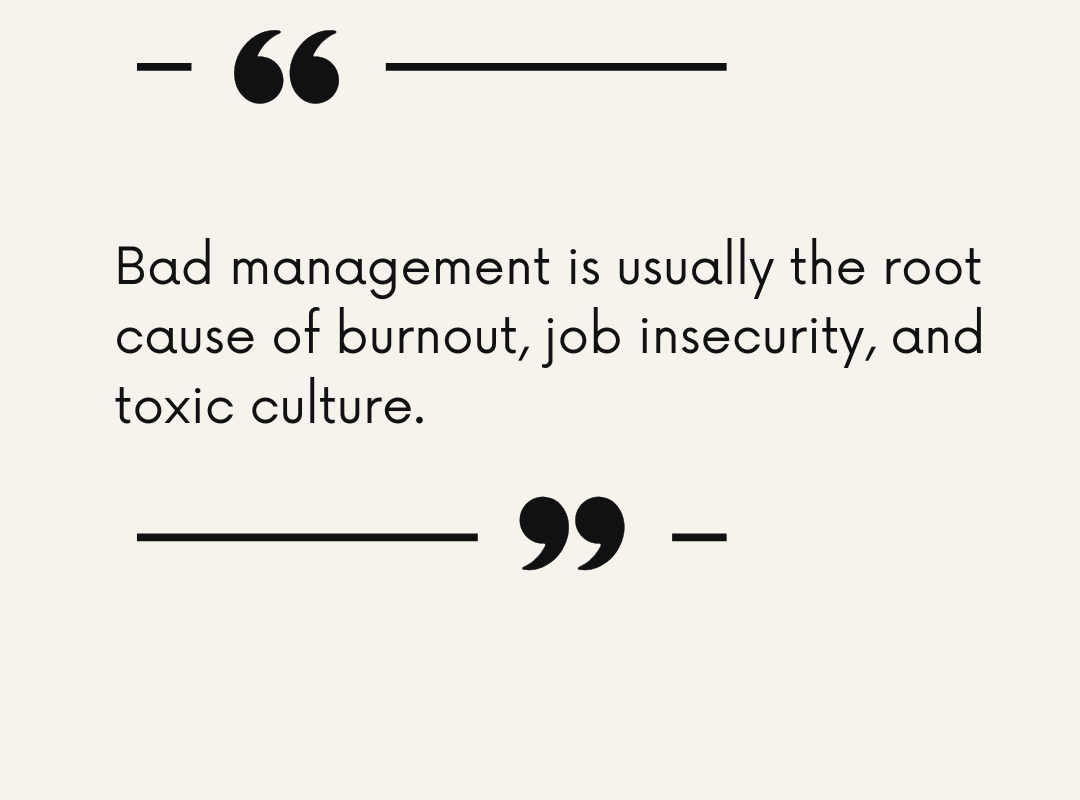
In practice, this looks like management by control rather than management by trust. It shows up as micromanagement, as information being withheld to preserve authority, as credit being taken rather than shared, and as difficult conversations being avoided because accountability feels riskier than silence. None of these behaviours announce themselves as toxic. They accumulate until people stop trusting their leadership altogether. When employees do not trust the people leading them, insecurity follows naturally, culture erodes from the top down, and burnout becomes the physical toll of working inside a system that no longer feels safe.
2. What are the top five signs of a toxic manager? Of all the bad manager types you have seen across your career, which one is the most dangerous and why?
The first thing I notice is expectation. Many toxic managers expect people to already be somewhere they are not yet, instead of meeting them where they are and helping them grow. That drives the second sign: unrealistic goals and timelines, handed down without much thought for what a team can carry. Patience disappears next: rarely any room to learn, make a mistake, or take time off, and that's often the first crack leading to a lack of empathy, where the human context behind performance gets ignored. But the one I see most is inconsistency: a manager whose mood shifts by the day, leaving their team guessing which version will show up, and that unpredictability, more than any single behaviour, is what strips away psychological safety.
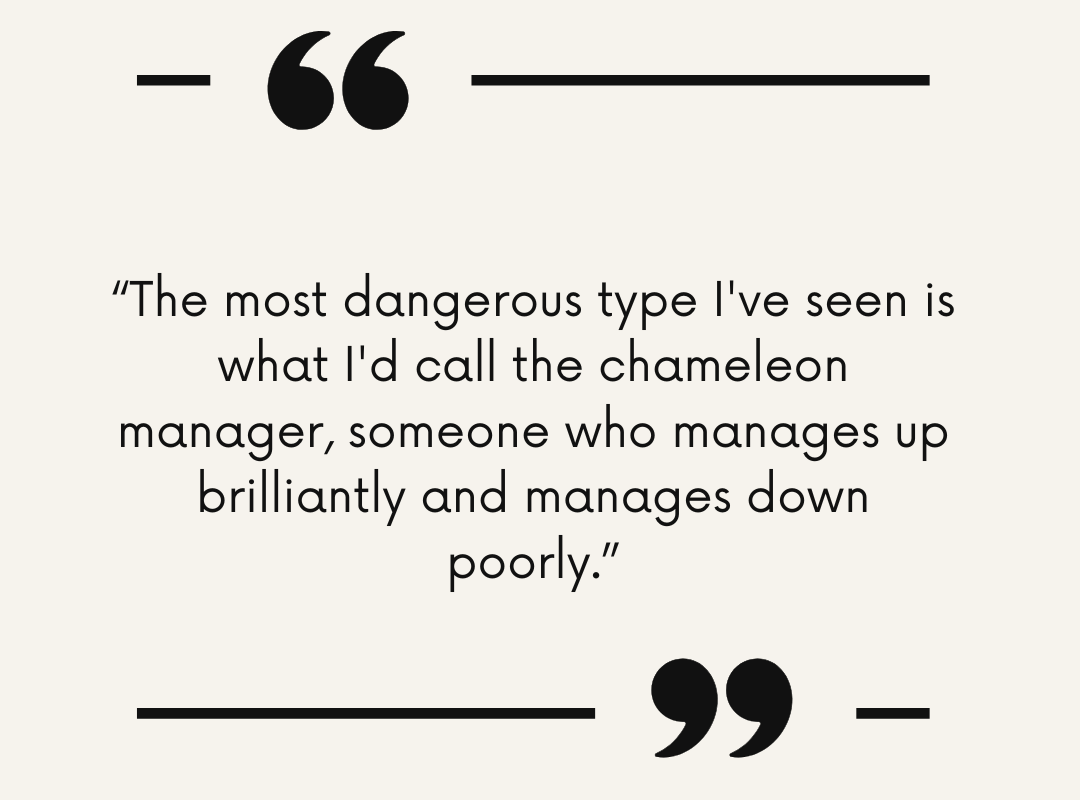
To leadership, they are polished, responsive, and easy to work with. To their own team, they are an entirely different person: controlling, dismissive, or quick to take credit while deflecting blame downward. What makes this type so dangerous is that the damage stays invisible to the very people who have the power to address it. Senior leadership sees engagement scores or turnover numbers and struggles to connect them to the manager everyone praises in meetings, because that manager has never given them a reason to look closer. Meanwhile, the team underneath is absorbing all of it, and the good people are usually the first to leave without ever explaining why. By the time the pattern becomes visible from above, the trust and talent it has cost are already gone.
3. Most bad managers do not think they are bad managers. They think they have high standards. What is the gap between how a poor people leader sees themselves and how their team actually experiences them and why does that gap stay hidden for so long?
The gap comes down to intent versus impact. Most poor leaders genuinely believe that holding people to a high standard is the same thing as being a good manager, so when they look at their own leadership, they see discipline, drive, and accountability. Their team, however, experiences something entirely different: a constant undercurrent of fear, a sense that mistakes are not survivable, and an environment where asking for help feels like admitting weakness. The manager is measuring themselves against their intention, while the team is living inside the actual impact, and those two things rarely match.
That gap stays hidden for so long because of how feedback naturally flows in most organisations. People are far more comfortable managing up than being honest with the person who controls their performance review, their next promotion, or their day-to-day experience at work. So the manager keeps receiving polished updates and surface-level compliance, and reads that as respect rather than self-protection. Meanwhile, the real feedback, the resignations, the quiet disengagement, the talent that stops volunteering ideas, gets explained away as personality clashes or people simply not being resilient enough. The manager is rarely lying to themselves on purpose. They simply have no accurate mirror, and nobody around them is incentivised to hand them one.
4. Why do bad managers often survive longer than good employees?
Bad managers often survive longer because their damage is slower to surface and easier to misattribute. A good employee who is struggling shows up immediately in performance metrics, so their exit tends to get noticed, questioned, and sometimes even prevented. A bad manager's damage, on the other hand, shows up in other people first: rising turnover, dips in engagement, talent quietly disengaging, and it takes far longer for that pattern to be traced back to its actual source. By the time it is, the manager has usually had years to build a case for themselves as reliable, results-driven, or simply "tough but fair."
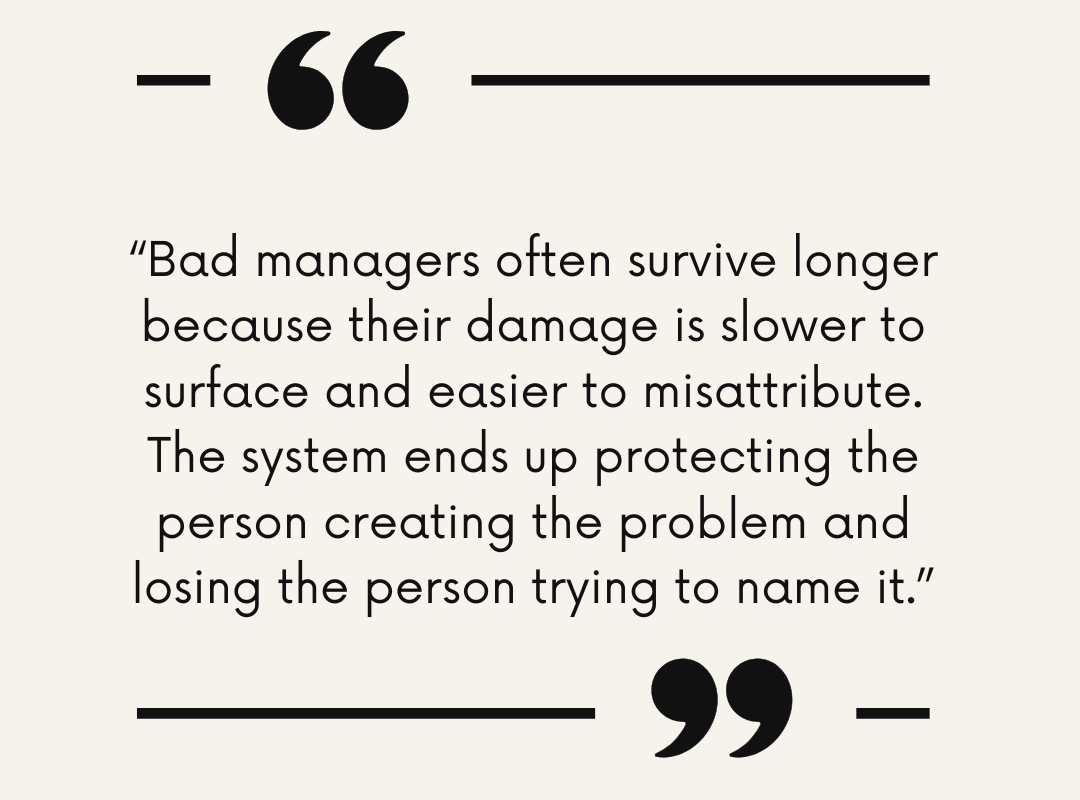
The other part of it is that organisations are often structured to reward the behaviours that make someone a bad manager while punishing the behaviours that make someone a good employee. A manager who hits targets, and keeps their team compliant on the surface looks successful on paper, regardless of the human cost underneath. Meanwhile, a good employee who raises concerns, pushes back on unrealistic expectations, or simply refuses to operate in a toxic environment is often labelled as difficult rather than principled. So the system ends up protecting the person creating the problem and losing the person trying to name it, simply because one of them is easier to measure than the other.
5. When people complain about a powerful leader, in your experience, what does the company typically do?
A: In a healthy culture, complaints are treated as data. The company investigates properly, speaks to the wider team rather than just the individuals involved, and is willing to accept that a high performer can still be a high risk. I have seen organisations quietly restructure a leader's role, bring in coaching with real accountability attached, or in some cases remove them entirely, because they understood that protecting one person was not worth losing the trust of everyone underneath them.
In a less healthy culture, the pattern looks very different. Complaints get minimised or reframed as personality clashes, and HR often ends up managing the optics of the situation rather than the substance of it. I have seen companies quietly move the leader sideways instead of addressing the behaviour, offer the affected employees an exit package instead of a resolution, or simply wait it out until the complaints slow down on their own. The underlying message in these cases is rarely spoken aloud, but it is always understood by everyone watching: the leader is more valuable to the business than the people reporting the harm, and that message alone is often enough to make good employees start looking elsewhere.
6. Both good and bad managers can get results. What is the difference in their outcomes that no one notices?
On paper, the outcomes can look identical. Both a good manager and a bad manager can hit targets, deliver projects, and produce strong quarterly results, which is exactly why the difference between them is so easy to miss from the outside. Results are visible. The way those results were produced is not, and that is where the real gap lives.
The unnoticed difference is what is happening underneath the numbers. A good manager can have a genuinely bad day, snap at someone, miss something important, or simply not show up at their best, and their team will still extend them grace, because there is enough trust and psychological safety already banked to absorb it. People know that one off day does not represent who that manager actually is, so respect holds steady even when the mood does not. A bad manager, even on their best day, is not building that same reserve. Every good result is achieved through pressure, fear, or control rather than trust, so the team hits the target, but nothing is being deposited into the relationship along the way. There is no goodwill sitting in the background for the day everything goes wrong.
That is really the hidden outcome nobody measures: one manager is building a team that can survive hardship together, and the other is running a team that only holds together as long as the results keep coming. The moment either manager has a genuinely difficult stretch, the true difference becomes impossible to hide, because one team stays and the other starts quietly planning their exit.
7. You work specifically on communication across generational lines. How does poor people leadership manifest differently across GenX, Millennial, and GenZ and the damage it does?
With Gen X, poor leadership shows up as a lack of transparency and a disregard for autonomy, and because this is a generation conditioned to just get on with it, the damage stays hidden the longest. They will not complain. They will not push back. They will simply stop giving their best thinking to a company that has stopped earning it, and continue showing up exactly enough to avoid consequence. A business can lose its most experienced people years before it ever loses their names off the payroll.
With Millennials, poor leadership strips out growth and purpose, and what it produces is a workforce quietly performing loyalty it no longer feels. This generation was promised that hard work leads somewhere, and a manager who cannot deliver honest development or a real sense of direction ends up managing a team that is technically present and completely checked out. The resignation letter, when it eventually lands, is never a surprise to the person writing it, only to the leadership who assumed presence meant commitment.
With Gen Z, poor leadership meets almost no tolerance at all. This is a generation that has watched older colleagues burn years of their lives absorbing dysfunction they were told to be grateful for, and they have simply decided not to repeat that mistake. Fear-based management or performative leadership does not get quietly endured here, it gets exited, often within months, without the loyalty debt previous generations felt obligated to pay first.
8. What does that tell you about how leadership communication has evolved or failed across generations?
Honestly, I think leadership communication has gone in two completely different directions, and the gap between them keeps widening. In a lot of older, more traditional companies, particularly in certain industries, there is still an underlying belief that mental health and psychological safety are not really the business's job to worry about, and if profit is holding up, there is no real pressure to challenge that belief. So what happens instead is companies learn to say the right things without doing much differently.
That is precisely why you will often find these companies full of long-serving, loyal Gen X employees, but struggling to hold onto Gen Z talent at all. It is not that Gen X employees are happier, they have just spent their whole careers inside a version of leadership where putting up with dysfunction was simply part of the job. Gen Z never learned that trade-off, so the moment the culture does not match what is being promised, they are gone, often before anyone even realises there was a problem.
But I want to be fair here, because I have also seen this done really well. The companies that get it right are usually the ones where leaders were willing to be genuinely uncomfortable, admitting when they got something wrong, actually listening to feedback instead of collecting it, and treating psychological safety as something they had to build through their own behaviour rather than something they could announce. In those places, you actually see Gen X, Millennials, and Gen Z working well together, because there is enough trust in the room for that to happen naturally.
9. If a person is promoted to the management role for technical performance, what does the transition from being a high performer to people leader actually require? What is the one thing organisations consistently fail to give new managers?
There is a vast difference between having technical knowledge and having the interpersonal skill required to lead people, and organisations consistently confuse the two. Being brilliant at the job does not automatically make someone equipped to manage the people doing it, because managing a task and managing a person are simply not the same skill. A task has a clear outcome, a deadline, a right and wrong way to complete it. A person comes with personality, mood, personal circumstances, ambition, insecurity, and none of that responds to the same logic that made someone excellent individually. The transition from high performer to people leader actually requires an entirely new skill set built around emotional intelligence, patience, and the ability to read what is not being said, and very few people are given the chance to build that before being handed a team.
The one thing organisations consistently fail to give new managers is any real training in how to lead people before expecting them to do it. Promotion becomes the reward for technical excellence, and leadership is simply assumed to come with the title, as though managing people is instinctive rather than a skill that has to be developed deliberately.
10. If a mid-career professional is reading this and recognising their own manager in the description, what is the one thing they can do that does not require the manager to change, but changes how much power the situation has over them?
I think the one thing that changes everything is remembering that as humans, we have the superpower of choice, even when it does not always feel that way in the moment. How much power we believe we have often comes down to conditioning, and that conditioning is generational. Twenty years ago, staying with one company for an entire career was considered the marker of success, and leaving was treated as a kind of failure. We have moved so far in the opposite direction since then that loyalty itself has been redefined, and I think that shift is worth sitting with, because it means the story you inherited about what you owe a company might not even be true anymore.
That pattern, more than any single bad day, tells the real story. They should also have real confidence in the years of experience they have already built, because that experience has value whether or not their current manager reflects that back to them. If they are genuinely not happy, the next step is not necessarily to leave immediately, but to get honest about what would actually make them happy.
The harder truth is that financial insecurity can blind us to all of this. It is very easy to stay somewhere we are not valued, or even somewhere we have stopped enjoying, because the fear of instability feels louder than the discomfort of staying. But recognising that fear for what it is, often the first real step toward remembering that the choice was always there all along.
11. At the The Mindset Consultancy, how do you help leaders translate who they are into how they show up. Can a bad manager's behavioural brand be rebuilt? If yes, how?
At The Mindset Consultancy, this work sits at the heart of what we call The Culture Code, because culture is never really written in a handbook, it is revealed in how people communicate when no one is watching. Before we ever try to change how a leader shows up, we have to help them understand what they are already communicating without realising it. Using CCR3 behavioural profiling, we uncover their behaviour, their values, and their emotional intelligence, giving us an objective picture of what is genuinely shaping their leadership beneath the surface, so the starting point is always self-awareness rather than behaviour change for its own sake.
That is really the foundation of translating who someone is into how they show up. Most people have never been taught how to communicate well in the first place. We absorb fragments of it from parents, early jobs, and whatever leadership we happened to witness throughout our careers, and we carry those fragments into every working relationship without ever questioning whether they actually serve us. So before I ask a leader to adapt to their team, I ask them to first build an honest relationship with themselves, understanding their behaviour, their values, and where their emotional intelligence supports or undermines them under pressure. Once that awareness exists, they are finally able to do the thing most bad managers never learn to do, which is meet people where they are, rather than where they expect them to be.
To answer the question directly, yes, a bad manager's behavioural brand can absolutely be rebuilt, but it requires exactly this order of operations. This is not about changing who someone is, it is about helping them communicate in a way that makes people feel seen, heard, and understood. I have watched leaders completely transform how their teams experience them once they finally see their own behaviour, values, and emotional intelligence clearly, because behaviour that was running on autopilot can always be rebuilt deliberately. What cannot be rebuilt is a leader who refuses to look inward at all, because no framework, including this one, can meet a team where they are if the leader has never taken the time to locate themselves first.
About Jessica Kelly
Jessica Kelly is an international communication and leadership consultant, mindset coach, podcast host and the founder and Managing Director of The Mindset Consultancy. Together with her team, she helps organisations strengthen clarity, connection, and culture across multi-generational teams.
With more than 15 years of experience spanning IT, brand development, and corporate wellbeing, Jessica has worked with leaders and organisations across industries including construction, telecoms, and professional services throughout the UK, Australia, and Asia. Her work combines behavioural profiling, executive coaching, and communication strategy to strengthen internal communication across teams and external communication that helps businesses clearly articulate who they are and what they do. This approach builds workplaces that are both psychologically safe and high performing.
.jpg)


%20(1).png)

.png)