




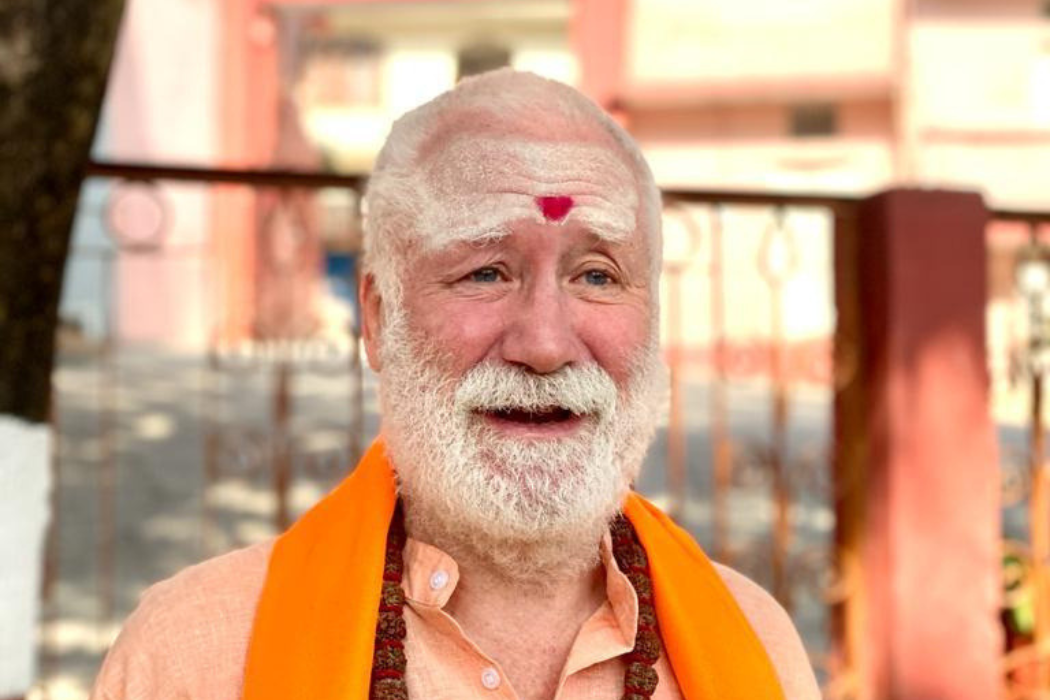
Q: You have operated at the peak of two extraordinarily demanding disciplines — financial markets and contemplative practice. Looking back, what did Wall Street teach you about the mind's capabilities — and what did it teach you about its limits?
A: I was living with Swami Muktananda, back in 1975. And I needed to pay rent to live in the ashrama so I would do odd jobs, earn a little cash to pay the rent for my time there. And when home one Christmas to this visit my family. And when I was there, my father told me that he'd started a new business, and it was drilling oil wells in the State of Ohio. And he asked me to come join me. So, when the asharam tour moved to New York, I moved into the New York City, asharam so I could live in the asharam practice meditation every day and go to work on Wall Street, raising the money to drill the oil Wells. So I was doing both at the same time in parallel.
What I was learning in my meditation practice, I was applying on a daily basis on Wall Street and it was very helpful because Wall Street is a very stressful place we were dealing with big stakes, multi-million-dollar contracts and then a lot of greed and upset. Early morning, I used to put my three-piece suit on and go to work. By the end of day, I would come home and be tense – upset, and I found that sitting in meditation, doing Pranayama practices, kirtan, chanting mantras really used to bring me back. People on Wall Street noticed that somehow, I was different than other people that I didn't have that kind of high paced, aggressive energy that was so common to people in my field.
So, I learned something different on Wall Street and in the asharam. They were really 2 sides of the same coin, and for me, the most important practice to stay centred was to meditate. I could set myself up for the day by meditating. Meditation used to go with me throughout the day, maintaining my peace, but accumulate some tension at the end of the day. And I could discharge it by simply meditating.
Once, I was invited to a small investment banking firm to make a presentation to the chairman of the board. And I remember going into his office, and he kept me waiting for over an hour. When I finally went inside his cabin to present our programme, within 10 minutes, he said my presentation was crap, numbers were inflated and he threw me out. I've been waiting for an hour to see him, and I got treated this way. I had time, I went to the park and sat there and decided to not let this incident upset me. But I was triggered, my heart was beating fast, and I was really mad - so I chanted the mantra ‘Om Namah Shivay’ repeatedly and it calmed me down, brought my heart rate to normal, my breath became stable and I was able to discharge the stress, the upset that I felt and I kept repeating the mantra.
And I felt love for this particular man, and the idea came, why don't I go back to his office and apologise to him for upsetting him, crazy idea, right? So, I went back and told the secretary that I'd like to apologise. He said he's busy right now and I can wait for him. I sat and in the waiting room. I just kept repeating the mantra and I was fully filled with love.
But he didn't want to see me and I could see the door which cracked open. And I could see that nobody was there in the room. I wasn't really doing anything but he was avoiding seeing me. Finally, he got fed up. He said “come on in”. I went inside and I told him that I just came to apologise for upsetting you, I hope I haven't ruined your day. And he said, you know, it really wasn't you, something happened before you came in, and I was already triggered and upset, please accept my apology and show me the programme again. I showed him the programme and he bought a multi-million dollar set of oil wells contract. So, it was a miracle, and it was also the practical application of Yoga that I was willing to forgive him to acknowledge my part in it.
Such experiences and that of Wall Street, were miraculous, when I look back at them, I was a 25-year-old kid who knew nothing about corporates, partnerships, investments. And yet, I was cast into this role.
Most of the clients that I got came through inspiration that I received in meditation. For example, I was sitting in the ashram meditating. I heard a voice inside, it said “open the security dealers handbook at page 529. So, at the end of my meditation, I opened up the page 529 of the thousand-page book, and there was this tiny little firm that zoomed out to me out of many different firms, Emerson. I picked up the phone and called them, I said, I'm David Nowe, and I manage oil and gas investments, and I was hoping to set up an appointment sometime in the future. You know, that's why these things work hoping to get maybe an appointment with the oil and gas analyst work my way up the chain. I told her what I was doing. She said, this is your lucky day. The chairman was there and the board is meeting, and they're discussing finding a programme to drill oil wells. Would you like to speak with them now? And I said, you bet, so she put me through, I got on the speakerphone and told them what I was doing and they asked me “how soon can you be here?” I said that I can be there tomorrow and they were my first clients!
This client continued for years and just after a few of these clients I was able to earn enough money to pay the taxes and retire for life and live with my guru for the rest of his days. So it was quite a miraculous experience.
Q: When did you first encounter meditation not as a spiritual practice but as something that changed the quality of your thinking, your focus, and your decisions? What shifted — and was it measurable to you?
A: I was first introduced to meditation in 1968 when I was a student at Colombia university. And my roommate took a course on transcendental meditation; he was excited about it and invited a bunch of us to come together to experience meditation. Now on this meditation course, they gave secret mantra which we weren’t supposed to share with anyone and asked the group to just have no thoughts. And I thought I was going to lose my mind. I had so many thoughts, I couldn't still my mind. I couldn't quiet my thoughts but I was inspired because it was the first time I'd ever actually looked inside myself. It was surprising, now when I look back at it because I'm so familiar with the mind and how I think and but it was completely new to me then that I could actually take my awareness turn within and watch my mind and thoughts. So, this and taught introspection and looking within through meditation.
I travelled around the world travel to the Middle East. I studied meditation with the Sufi masters. I spent some time in a Zen Buddhist monastery in Japan and studied Yoga, learnt meditation, including transcendental meditation. I did take a course in transcendental meditation in 1972 and for me, meditation, never about sort of the mundane benefits of it.
I was young, I was healthy, so I wasn’t concerned about blood pressure or relaxation. From the beginning, I wanted to know a deeper part of myself. And those days, I was reading book about kundalini and shakti, and it just seems so mystical and so magic that I was curious to find out about it, and so meditation and the pursuit of spirituality became the core of my being.
Q: Neuroscience is now confirming what contemplative traditions have known for centuries — that meditation physically reshapes the brain. For a senior professional who has never meditated, what is actually happening inside their mind that is costing them performance they don't even know they're losing?
A. Stress. Stress. Stress - contracts the mind and really inhibits our ability to perform a lot of people. Feel that nervousness or anxiety or those sorts of energies can help them to be more productive. You know, I have found the opposite to be true. That's long as we're existing in the fight or flight modality inhibits our ability to think clearly. So that's what one level quitting. The mind. Stilling, the vertices is the yogis would say allows us to perceive reality as serious and also opens us up to inspiration. I feel that those experiences I had in meditation that I shared earlier were inspirations from the divine, I experienced it as a voice, but really was coming from my own inner being. It wasn't from some external being, and they have a word for this in the tradition of shavism 'Pratibha', the download, the inspiration that comes from the highest part of our own being. It doesn't come from an outside source so we may hear express itself as a voice.
You know, we think it's outside, but it's really our own highest good at speaking to us. So It quits the mind and allows it to function. It's highest capability, and it opens up our potential to receive information from our higher mind.
Q: Imagine someone gets inspired by you with this interview today, and they start meditating, so how long would it take for them to notice a change?
A. Many people experience the change the first time they meditate. That they feel using a Mantra or focusing on the breath, they can actually literally feel attention dissolving. It made me take some regular daily practice. In order to completely reset the nervous system and to reset the mind in such a way that we can learn to live in a relaxed state. So many people who meditate and go through several stages of development. Of the course of adulthood, most, you know, in developmental psychology, they say that we typical adult might grow a maybe a stage or 2 from the age of 25 to 45, usually the busy racing of family, making money that they don't really grow but meditators who've really practiced meditation.
Can go through an entire stage of development every 2 years. So by doing that practice, you can learn how to control the mind. How to focus the mind and you begin to recognise?
As you focus the mind that the mind creates a reality by focusing our mind, becoming clear on what it is that we desire, what we want to achieve having that clarity and using our minds to direct that meditation. Helps the manifestation of our dreams.
Q: This has been my personal experience. So many of us in the corporates who are high achievers, believe their restlessness, they are racing mind, their relentless drive are what make them successful. So what would you say to someone who is afraid that a calmer mind might make them less sharp, less hungry, less competitive.
A. That's a good question. You know, my Mother and Father didn't completely support my movement into meditation and Yoga. They wanted me to take over the family business.
So they was raised Catholic and kind of moving into a different tradition was not something they completely supported, but after a few years in Indian, when I came home. They know notice the transformation my Mother said, you know, you've become patient, you've become kind, and these were not qualities that were natural from me. I was an overactive compulsive achiever.
I lived on the anxiety. I was filled by adrenalin and caffeine, you know, but once I learned that those things are can feel like their motivations, because you get the high from it. The deep Impulse to success, it comes from a deeper place than anxiety and from induced energy, taking a substance like caffeine or I know in Wall Street, they use a lot of drugs and things like that, it's easier and more effectively more productive.
If you can tap into. You're inner, knowing you can tap into the place of inspiration. The 2 stories that I shared about being given the guidance, it wasn't from an external source was because my mind was quiet.
I had a clear intention and the answer was revealed in the silence. So in my own case, I became more successful, the less stress ruled my life.
Q: Because a lot of people confuse relaxation with meditation, and they confuse switching off and training the mind. So, how do you explain that distinction to someone who's only experience of stillness is either sleep or a vacation?
A. So meditation, you know, is a lot like sleep. It's stilling the movements of the mind and the tradition of potentially the Yoga sutras is the sutras as Yoga, Chitta Vritti nirudha, the Yoga is the stilling the Vritti of the mind the movement of the mind. Where they were thinking or remembering or creating these are all movements of the mind.
And so we practice Yoga, we meditate to quiet the mind, and our natural habit is when there's no thoughts in the mind is quite we fall asleep, right? So the Yogi learns to quiet the mind, but remain conscious. We can even go into this state of deep-sleep and remain perfectly conscious, because just the other side of that dark, deep-sleep just pass the veil evolution is the inner self, and if you really look at your experience of sleep at night, if you don't get good sleep at night, you don't have any energy, right?
Or even if you have a good night sleep, you work hard during a day. You expand all the energy, and then what you do you go to sleep at night. You quiet the mind you don't quit the mind.
You can sleep, so you get it a good night's sleep. And in this deep-sleep, you're going close to the inner self, that's the battery that's the charge. The differences that mostly go unconscious, where the Yogi remains fully awake, fully conscious, even in the deep-sleep state.
So why they say that the ‘atman’ is eternally present, it's always conscious, and it begins at the higher stage of meditation to remain fully conscious the state of waking dreaming deep-sleep. So, it's it's doing something that's very natural to us going to sleep. But remaining conscious is true deep meditation.
Q: Great, what a great revelation. It is for our audience. So sir, my next question is that you have sat with some of the most driven high-functioning minds in the world, what is the most common thing that happens when a high achiever first sits in genuine silence, and what does that reaction reveal about them.
A. What I have found and this may not be everyone's experience, but what I have found is it really high performing individuals have the capacity to meditate very deeply. They've already learned to focus the mind in order to achieve to reach where they are so in this stages of meditation, we first all, have the intention. To meditate, so we begin to lessen the number of rites, and we can do that through choosing a Mantra or meditating on a candle or on the breath.
So we begin to focus the mind on one point or one pointed mind ‘ekagrita’. So, we practice as one pointed awareness, when that one thought falls away.
Then, we're going to Samadhi (into absorption). So many people at the practice and take years to get to the state where they can focus on one point, whereas achievers already have achieved that through their business. You know when I introduced my Father, to my baba, I was the MC for the programme and after Baba's presentation I brought my Father back to meet Baba and when he met Baba, Baba said,"you're a great Yogi, and then he looked at me and baba said your Father's a great Yogi.
And I got jealous, I said, what do you mean, Baba? He said he's a great Yogi, because he's mastered the business, he's done the Yoga of business, and he's a master of it, and he said, you have a lot to learn from your Father, and I realised the point of Yoga, so quickly, at such a young age -It's my Father, who has been teaching the basic principles in a secular form. He taught me about how what the mind can conceive, and believe it. He was an instructor in the alternative courses, which is another form of meditation.
Q: So a lot of people have this question in their mind that I'm going to actually ask you now. So for a professional with a demanding schedule, a family and a calendar that leaves no white spaces for them. What does a meaningful meditation practice? Look like for them. What is the minimum that is still transformative for them?
A. Well, I'm encourage people to meditate on a daily basis. That's how you can really meditation. The practice meditation over a long period of time, on a consistent basis will bring about fruit. I would say a minimum of 20 to 40 minutes is good, an hour would be amazing. Dedicate the time to meditate for 20 minutes is a good way to start. Make it consistent, pick the amount of time that you're going to devote at the same time everyday. Just sit for the full amount every day and then it will bear fruit. Some people like to break it up 20 minutes in the morning, 20 minutes in the evening. I know that's the practice transcedental meditation. I did that for almost 7 years. And then when I met my guru Swami Muktananda, he said meditate for an hour in the morning and so I did that, I don't think I missed a single daysince then, even when I travel, I meditate at 4:30 am , even if I am in flight. It's a good addiction to have.
Q: Decision fatigues are is one of the most expensive hidden costs in leadership. How does a sustained meditation practice change the quality of decisions that the professionals make at their workplaces under pressure or in conditions of uncertainty?
A. Being able to go into the stillness. And to see things clearly shortens the decision-making process, if you can see clearly what the options are. It's a lot easier to make decisions when the mind is overactive under stress. In 'fight or flight' mode, clarity is lost and it becomes very difficult, maybe even paralysing for some people to make decisions. So it's helpful when you're in that state, you just sit quietly, meditate, and be able to see more clearly what's the right path that you can take.
Q: Wonderful, thank you. Thank you so much for that. So the highest performing organisations in the world from boardrooms to elite sports teams are beginning to take the science of the mind as seriously as the science of strategy. Where do you see this going? And what will separate the leaders who embrace it from those who don't
A. You know, there was a period of time where I was living outside the ashram, and I worked as a corporate consultant. And was brought in to many of the fortune 500 companies to work with them to work with their either CEO, their corporate executives in how to meditate. In how to still the mind, how to be quiet, so I do feel that it has a place in the corporate region. And I feel that those who understand the nature of the mind, who understand the nature of high performance will incorporate some of these spiritual practices without making them religious, meditation doesn't have to be a religion. You can be an atheist. You can be in any religion or not. In any religion, it's about your own self of learning to understand your own mind and coming to know who you are. And one of the benefits of meditation is this understanding of who we are and an understanding of our capacities, we understand our talents, we understand how to make the best use of our gifts. So, I believe every employee, every executive, would become more productive by understanding the nature of the mind and understanding who am I and what's my function?
Q: If a senior professional picks up this piece that we are doing today with you during a rare quiet moment and feels something stirred in them a recognition that their mind deserves the same investment as their career. What is the single first step? You would guide them toward?
A. I would encourage them to find a place where they can learn how to meditate. They can sit quietly on their own and meditate. It's easier if you have an experienced teacher to show you. Because it's It's natural for us. But and it's simple. But it's certainly easy. So it takes a little practice. There are tools, there's a wonderful scripture in shavism, called the Vigyan Bhairav Tantra, where they describe a 112 different forms of meditation. So I would encourage the readers to find someone who could teach them one of these practices. You don't need to learn all of 112. You just need one that you can do on a regular basis. Find a meditation teacher and learn to practise.
Q: What are the topmost 2 books that the corporate people can read to get themselves started on their enlightenment journey?
A. There are 2 books. It's very well written books by serious practitioners who are close friends. The first book is written by Sally Kempton. It's called The Heart of Meditation: The Pathways to a Deeper Experience. She has described in great detail how to meditate, and issues and the problems that people have in getting into meditation. She's an excellent writer and a seasoned practitioner. The other book is a little more philosophical, it's called Kashmiri Shavism. Everything is consciousness, consciousness, is everything by my dear friend, Swami Shankarananda, he's a western practitioner who's been practising almost 60 years and a former English Proffessor.
Q: If they want to get in touch with you and receive Shaktipat or this tremendous energy that you carry, what are the mediums that they can actually get in touch with you.
A. I do maintain a WhatsApp group called Brahmananda Sangha, and it's there that I post my travels schedules. I'll be travelling to 18 countries be in Europe, North America, South America, Asia, and if you would join will be providing a link to join and you can meet me in any of these places I offer a 2 day meditation intensive where in this workshop, the transmission of meditation energy takes place spontaneously and naturally and simply by being in that environment will empower you too deep into meditation, I do have a website in development. But it's not ready to be launched yet. So I'd like to love to meet you somewhere along your journey.
--Ends--
Biography Swami Brahmananda Saraswati
Born: David Donald Nowe March 2, 1950 in Pittsburgh, PA USA
Met Swami Muktananda and received Shaktipat Initiation in August 1975. Did Sadhana with Muktananda in his ashrams for next 8 years.
Practiced Siddha Yoga and studied Kashmir Shaivism and Vedanta philosophies. In 1980 received Sanyasa Diksha and was given the name Brahmananda.
In 1981 Muktananda instructed Brahmananda to establish an Ashram in Los Angeles, California, which became Siddha Meditation Center Los Angeles. Muktananda appointed him as National Coordinator of SYDA Centers and Ashrams in US including 35 Ashrams and 350 Meditation Centers.
Brahmananda was very active in Interfaith ministries in the USA and has traveled to more than 75 countries. In 1995 Brahmananda founded the God Realization Ministry which taught the principles of Siddha Yoga in more than 200 Christian Churches in the USA.
From 2015-2019 was the Spiritual Director of Simple Peace Retreats in Assisi Italy. Taught weekly silent meditation retreats for 5 years. Retreat Center was named A Top Ten Retreat Center in the world by numerous media including CNN, Newsweek, Travel and Leisure Magazine and many more.
Brahmananda has been offering Satsangs and conducting Shaktipat Intensives in India past 4 years. Brahmananda is a graduate of Columbia University in New York City. He has also studied at Universities in France, Lebanon and Japan.
Brahmananda says “Meditate on your Self. God dwells within you as You.” And “See God in Everyone.”
.png)

.jpg)


%20(1).png)

.png)